Decorative Collective - www.decorativecollective.com
Sellers's Details
BAGGOTT & CO
Tel:
Email: [email protected]
https://www.decorativecollective.com/dealers/baggott-coItem Details
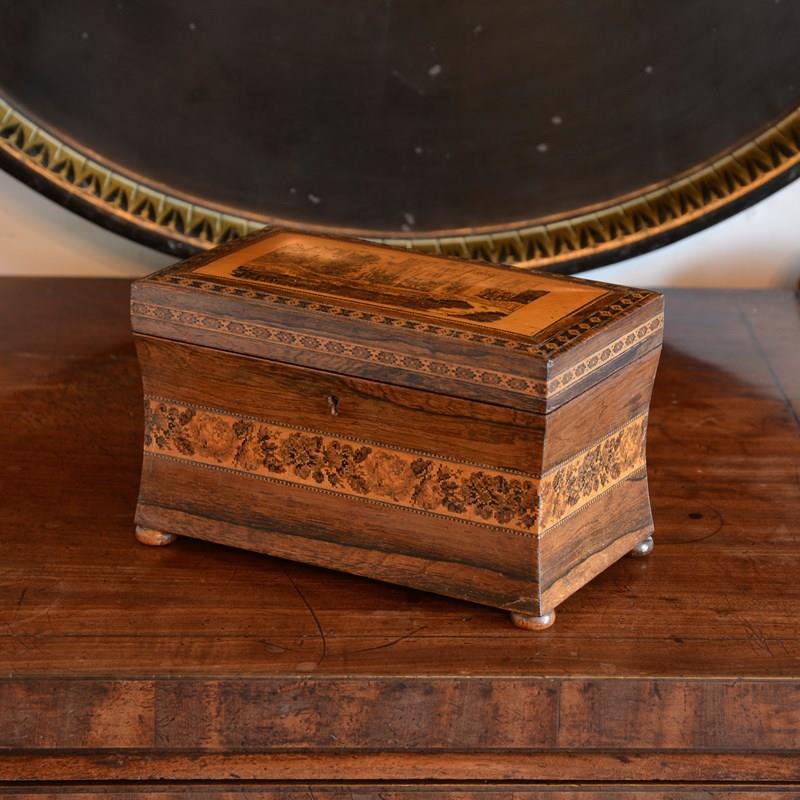
Tunbridge Ware rosewood tea caddy attributed to Henry Hollamby
Of concave sarcophagus form with tessellated and floral inlay, the lid with central panel depicting Hever Castle, opens to an interior with two lidded foil lined tea boxes. Stands upon turned bun feet.
English, circa 1860-1890
Tunbridge ware is the collective term given to a form of decorative inlaid woodwork in which small pieces of different coloured woods are used to form a mosaic or geometric pattern. As its name suggests, the technique was developed in the historic Kent town of Tunbridge Wells from the mid 18th century.
Tea caddy attributed to Henry Hollamby (1819-1895
The Hollamby family was involved in the Tunbridge Ware industry in the very early part of the nineteenth century. At the age of 12 in 1831, Henry was apprenticed to George & James Burrows, and, by the age of 26, was running his own business at 6 Edgar Terrace in the High Street. Ten years later he had premises in both Chapel Place and on the Parade along with a manufactory employing upwards of twenty people in Frant Road, Tunbridge Wells.
Hollamby specialised in the portrayal of famous buildings and places on his work which was both retailed and wholesaled to other sellers in the town, and pictorial blocks were also sold to other towns in both England and Ireland. He exhibited at both the Crystal Palace Exhibition of 1851 and the 1862 Great Exhibition with considerable success The business closed in 1891.
Hever Castle, Kent, England
Hever a 14th century medieval defensive moated castle, about 10 miles from Tunbridge Wells, with its gatehouse and walled bailey, was built in 1383. In the 15th and 16th centuries it was the home of one of the most powerful families in the country, the Boleyns, who modernised the existing dwelling within the walls.
The Castle was to become the childhood home of Anne Boleyn, King Henry VIII’s second wife, who became Queen of England for just 1,000 days. It was Henry’s love for Anne and her insistence that she became his wife rather than his mistress that led to the King splitting from the Church in Rome and creating the Church of England, forever altering the course of English and European history.
Hever later passed into the ownership of another of Henry VIII’s wives, Anne of Cleves, and from 1557 onwards it was owned by a number of families including the Waldegraves, the Humphreys and the Meade Waldos.
[Ref: Hever Castle website]
- Period:
-
- Price: £1,250.00
- €1,458 Euro
- $1,673 US Dollar
- Location: Scotland
-
- Dimensions: H: 13cm (5.12in)
- W: 21.5cm (8.46in)
- D: 13cm (5.12in)