Decorative Collective - www.decorativecollective.com
Sellers's Details
CHESHIRE ANTIQUES CONSULTANT LTD
Tel:
Email: [email protected]
https://www.decorativecollective.com/dealers/cheshire-antiques-consultant-ltdItem Details
Fine Carved Oak & Fruitwood Wall Plaque – Colonel Sir Edward Massey, Governor of Gloucester 1642 – English Civil War Portrait from Earlier 18th-Century Oak, in the Manner of Victorian Gothic Work Associated with Sir George Gilbert Scott
Overview
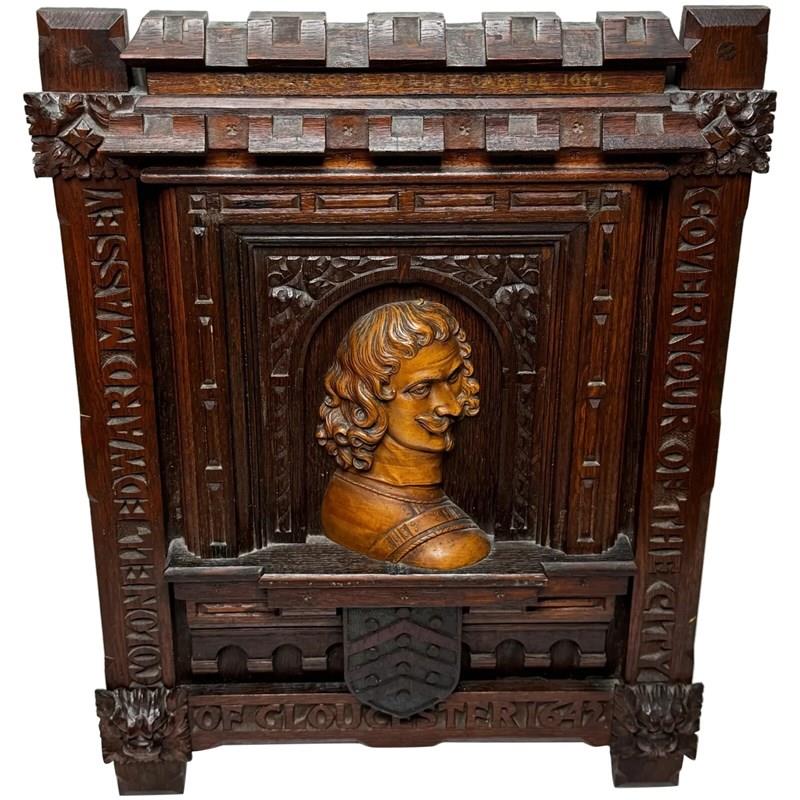
A dramatic and atmospheric carved oak and fruitwood wall plaque depicting Colonel Sir Edward Massey, the noted Governor of Gloucester (1642) and later Governor of Sudeley Castle (1644) during the English Civil War.
The plaque is constructed from earlier oak boards (very likely 18th century or earlier), which were subsequently carved and assembled in the 19th century in a romantic historic / Gothic Revival style. It brings together genuinely old timber, a documented historical figure and vigorous carving to create a decorative piece of real presence and character.
Subject & Design
At the centre is a high-relief profile portrait of Colonel Sir Edward Massey, his head tilted slightly upward. He is shown with abundant, curling hair and a curled moustache, his features strongly modelled and his breastplate of armour crisply defined. The head and bust are carved from fruitwood, which has acquired a warm, honeyed tone that stands out superbly against the darker tiger oak surround.
Framing the portrait is an architectural oak structure evoking castle walls and battlements: a foliated arched niche, side uprights with geometric ornament, a crenellated top rail and a lower frieze of small arcaded openings recalling a fortified gateway.
Running around the outer frame is a deeply carved inscription:
“COLONEL EDWARD MASSEY – GOVERNOUR OF THE CITY OF GLOUCESTER 1642”
Across the top, in gilt lettering, another inscription reads:
“GOVERNOR OF SUDELEY CASTLE 1644”
Suspended beneath the bust is a heraldic shield with chevrons and roundels, echoing the historic arms associated with the city of Gloucester. Each lower corner is filled with a vigorous green-man / lion-mask carving – full of life and precisely the kind of flourish typically favoured by Gothic Revival carvers.
Historical Interest
Edward Massey (c.1619–1674) was a prominent figure in the English Civil War. As deputy governor and later Governor of Gloucester, he gained renown for his determined and energetic defence of the city in 1643. Subsequently appointed Governor of Sudeley Castle, he was closely involved in some of the most dramatic phases of the conflict and its aftermath – wounded at Worcester, imprisoned in the Tower of London, escaping captivity and ultimately returning to the Royalist side.
Following the Restoration he was knighted and served as Member of Parliament for Gloucester. This plaque commemorates his role as defender of Gloucester and commander at Sudeley, making it an especially attractive piece for collectors interested in Civil War history, early English politics and heraldic or military portraiture.
Maker & Collecting Context
The exact sculptor is, as is usual with carved oak of this type, unknown. Stylistically, the work belongs firmly to the Gothic Revival tradition of the 19th century and recalls the portrait reliefs associated with architects such as Sir George Gilbert Scott and their workshop sculptors – romantic historical heads placed in architectural settings, accompanied by heraldry and inscriptions to evoke a sense of continuity with the “Age of Oak”.
This combination of genuinely old timber, Gothic ornament and a named historical subject has long appealed to serious students and collectors of oak furniture. In the late 19th and early 20th centuries, connoisseurs like Percy Macquoid (author of A History of English Furniture) helped establish the taste for early English oak and panelled interiors, illustrating carved oak from major country-house collections. Later, experts such as Victor Chinnery (Oak Furniture: The British Tradition) developed and refined this field further, advising many important collections.
On a larger scale, great collectors such as William Randolph Hearst amassed extensive quantities of medieval and Gothic woodwork, architectural fragments and carved panels to create evocative historic interiors. Although this plaque does not derive from those collections, it is exactly the sort of bold, atmospheric panel that would sit comfortably in an oak-lined hall, library or castle-inspired room.
Today, comparable pieces remain very desirable to collectors of early oak, Gothic Revival carving, heraldic decoration and English Civil War memorabilia, as well as to decorators looking to introduce genuine “country-house” texture and authenticity.
Why You’ll Love It
Real age and patina – earlier oak boards with visible old tool marks and a deep, natural colour, enlivened by later romantic carving.
A named Civil War figure – not a generic portrait but a specific historical personage whose story can be told.
Strong decorative impact – almost 70 cm in height and around 6 kg in weight, with the visual presence of a small overmantel or architectural fragment.
Detail wherever you look – the warm fruitwood bust against tiger oak, the heraldic shield, the green-man masks and gilt lettering all draw the eye.
Ideal for a period interior – perfectly suited to a fireplace wall, staircase, hallway, library, study or “gentleman’s room”, where it immediately feels at home in a panelled or country-house setting.
Dimensions
Height: 68.3 cm
Width: 52 cm
Depth: 4.5 cm
Weight: just under 6 kg
Provenance & Notes
From an overseas private collection and a notable Channel Islands auction house; later in the collection of Cheshire Antiques Consultant LTD.
Offered as an antique decorative carved plaque of Colonel Sir Edward Massey. As with all historic objects, prospective buyers are advised to study the photographs carefully and rely on their own judgement.
Condition Report
This is an antique decorative piece with genuine age and wear, presented in good, sound, usable condition with considerable charm.
The surface displays scuffs, grazes and scratches consistent with many years of handling and display. There are small chips and minor losses to some of the carved high points and edges. As one would expect in old oak, there are age-related splits and slight separations in the timber; these appear stable and are regarded as part of its character rather than a structural issue.
The colour is attractively varied, with older stains, darker passages and a rich, developed patina that only forms over long periods of time. The reverse shows signs of old repairs and later screws used to secure the panel. A hanging wire is currently fitted; given the weight of the piece, a new owner may wish to inspect and, if necessary, upgrade the wire and wall fixings to suit their chosen setting.
Please examine all photographs closely, as they form an important part of the description.
Worldwide Shipping Available
Professionally packaged and fully insured worldwide shipping is available.
- Period: Carved19th century
-
- Price: £4,950.00
- €5,851 Euro
- $6,559 US Dollar
- Location: London
-
- Dimensions: H: 68.3cm (26.89in)
- W: 52cm (20.47in)
- D: 4.5cm (1.77in)