Decorative Collective - www.decorativecollective.com
Sellers's Details
CHESHIRE ANTIQUES CONSULTANT LTD
Tel:
Email: [email protected]
https://www.decorativecollective.com/dealers/cheshire-antiques-consultant-ltdItem Details
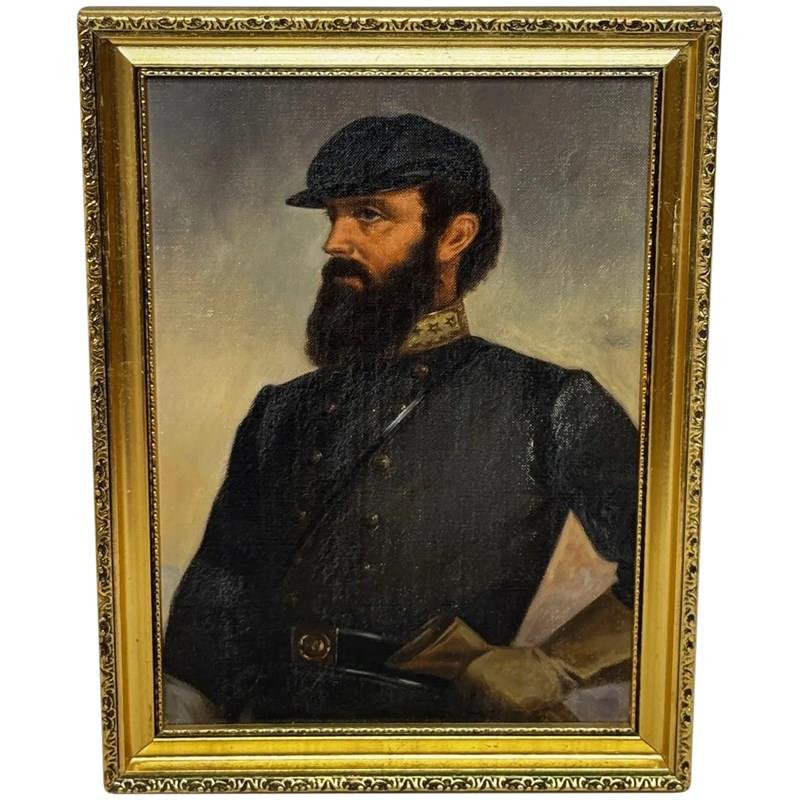
Thomas “Stonewall” Jackson Historical American General Oil Portrait, 1954 – After John Adams Elder
Subject & Medium
Oil on canvas, dated 1954.
This mid-20th-century historical portrait depicts Confederate General Thomas Jonathan “Stonewall” Jackson (1824–1863), rendered in the established 19th-century format popularised by John Adams Elder. The composition follows the recognised visual archetype that shaped Jackson’s enduring presence in American Civil War iconography.
Executed in traditional oil on canvas, the work displays tonal depth, subtle glazing, and the permanence associated with academic studio practice.
Composition & Technique
Jackson is presented in dignified three-quarter profile, dressed in Confederate frock coat with brass buttons, leather belt, high collar insignia, and cap. His steady gaze and composed posture project restraint and authority—qualities closely associated with his military reputation.
The subdued background isolates the figure, reinforcing formal portrait hierarchy. The palette is controlled and sober, comprising deep greys, umbers, and muted golds consistent with historical military portrait conventions.
Technical characteristics include:
Layered oil construction
Careful tonal modelling of facial structure and beard
Subtle glazing within shadow passages
Controlled highlights on metallic uniform details
Visible but disciplined brushwork
The painting reflects mid-20th-century historical revival sensibilities, consciously preserving 19th-century compositional standards.
The Sitter: Life, Education & Formation
Thomas Jonathan Jackson was born on January 21, 1824, in Clarksburg, Virginia (now West Virginia). Orphaned at a young age and raised in modest circumstances, his early life was marked by hardship and self-discipline.
Despite limited formal schooling, Jackson secured admission to the United States Military Academy at West Point in 1842. Entering with academic disadvantages, he advanced steadily in class rank and graduated in 1846, 17th out of 59 cadets.
He served with distinction in the Mexican–American War (1846–1848), earning brevet promotions for gallantry.
In 1851, Jackson accepted a professorship at the Virginia Military Institute (VMI) in Lexington, teaching artillery tactics and natural philosophy. Though regarded as strict and unconventional, he was deeply committed to discipline, faith, and personal duty.
He married first Elinor Junkin, who died shortly after childbirth, and later Mary Anna Morrison, with whom he had a daughter.
Military Career & Civil War Legacy
At the outbreak of the American Civil War in 1861, Jackson joined the Confederate cause. His brigade earned the nickname “Stonewall” at the First Battle of Bull Run when he was described as standing “like a stone wall” under fire.
His most celebrated campaign occurred in 1862 during the Shenandoah Valley Campaign, where rapid manoeuvres and strategic deception enabled his smaller force to defeat multiple Union armies in succession. His operational mobility remains studied in military academies.
Jackson later served under General Robert E. Lee in the Army of Northern Virginia, playing significant roles in the Seven Days Battles, Second Manassas, and Fredericksburg.
In May 1863, following a successful flanking manoeuvre at Chancellorsville, Jackson was accidentally wounded by friendly fire. Complications from pneumonia led to his death days later at age 39.
His early death contributed substantially to his mythic status within Confederate memory and Southern historical narrative. His image became central to Civil War portraiture, widely reproduced in engravings and painted versions derived from the composition by John Adams Elder, which this 1954 work follows.
About the Artist
Signed “C. Wood” and dated 1954 to the reverse, the artist demonstrates a clear understanding of academic portrait conventions and historical prototype referencing.
While not widely documented in institutional records, the execution suggests formal training and deliberate engagement with established Civil War portrait archetypes. By referencing Elder’s recognised composition, the artist situates this work within a continuing visual tradition preserving 19th-century Confederate imagery into the mid-20th century.
Signature
Inscribed verso in white paint:
C. Wood 1954
The inscription appears contemporaneous and confidently applied.
Frame
Housed in a later gilt moulded frame of traditional character. The warm gilded finish complements the restrained tonal palette and enhances presentation within formal interiors.
Size
Frame: 29 cm wide × 38 cm high × 2.5 cm depth
Canvas: 21 × 30 cm
A refined cabinet-scale format suitable for display in a study, library, or curated Civil War collection.
Provenance
Private collection.
Curated by Cheshire Antiques Consultant LTD.
Painted after the recognised composition by John Adams Elder.
Condition Report
Canvas structurally stable
Surface wear consistent with age
Areas of paint loss and visible craquelure under close inspection
Minor fading and scuffing
Colours muted in places
Later gilt frame with age-related chips and surface marks
Overall, the painting presents acceptably at normal viewing distance and retains clear period character.
Worldwide shipping available. Professionally packaged and fully insured for safe international delivery.
Explore our gallery, Cheshire Antiques Consultant LTD, for further curated works of historical and decorative interest.
- Period: 1954
-
- Price: £5,000.00
- €5,898 Euro
- $6,599 US Dollar
- Location: London
-
- Dimensions: H: 38cm (14.96in)
- W: 29cm (11.42in)
- D: 2.5cm (0.98in)