Decorative Collective - www.decorativecollective.com
Sellers's Details
CHRIS HOLMES ANTIQUES
Tel:
Email: [email protected]
https://www.decorativecollective.com/dealers/chris-holmes-antiquesItem Details
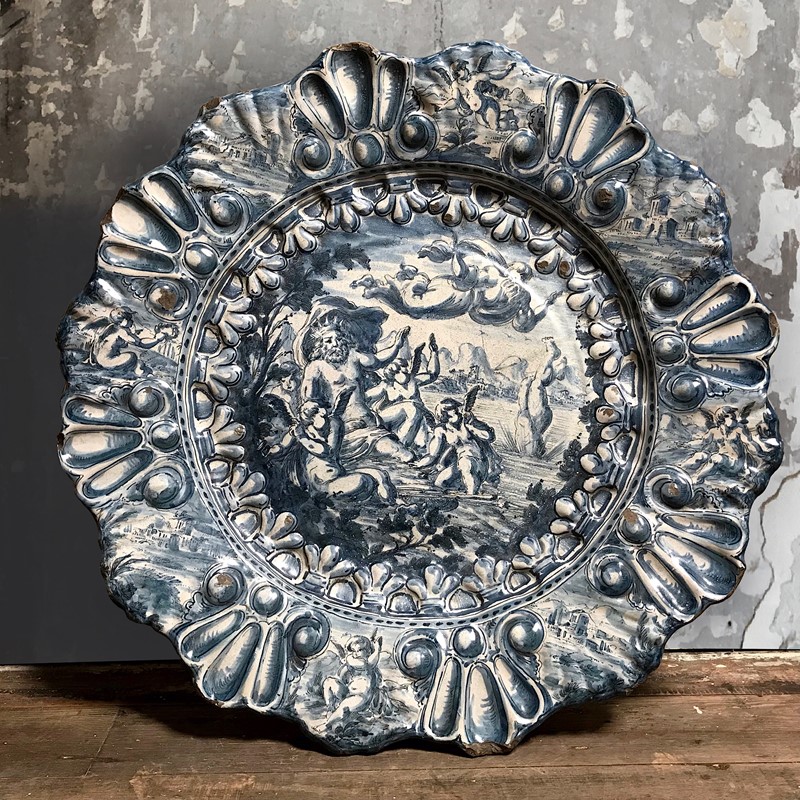
A Savona-Tradition Blue and White Maiolica Charger, Liguria
A monumental blue and white maiolica charger in the Savona tradition, hand-painted in cobalt blue with a dramatic mythological marine scene of Neptune attended by putti amidst turbulent waters and swirling drapery, set within a boldly moulded border of alternating shell forms, bosses, putti, and landscape reserves — characteristic of the sculptural "plastic" style associated with Ligurian baroque maiolica.
The charger has striking architectural presence at 64 cm in diameter, its deeply moulded relief border creating dramatic shadow and movement across the surface. Maiolica refers to the richly tin-glazed earthenwares of Italy's Renaissance and baroque periods; here the soft opaque glaze is painted in monochrome cobalt blue, in conscious dialogue with the Chinese porcelains that so profoundly influenced European decorative arts.
The reverse bears an underglaze cobalt monogram — a crowned heraldic device over the letters "GAG" — relating to the Savona workshop tradition associated with the Guidobono family, active in Liguria in the second half of the 17th century.
Provenance: Christie's, "The Collector," 27 January–10 February 2022, lot 117, A Savona Maiolica Blue and White Charger, Late 17th Century, Shield over GAG Monogram Mark.
- Period: c.1660-1680
-
- Price: Above £5,000.00
- Above €5,911 Euro
- Above $6,626 US Dollar
- Location: Yorkshire
-
- Dimensions: H: 64cm (25.20in)
- W: 64cm (25.20in)
- D: 7cm (2.76in)