Decorative Collective - www.decorativecollective.com
Sellers's Details
CHRIS HOLMES ANTIQUES
Tel:
Email: [email protected]
https://www.decorativecollective.com/dealers/chris-holmes-antiquesItem Details
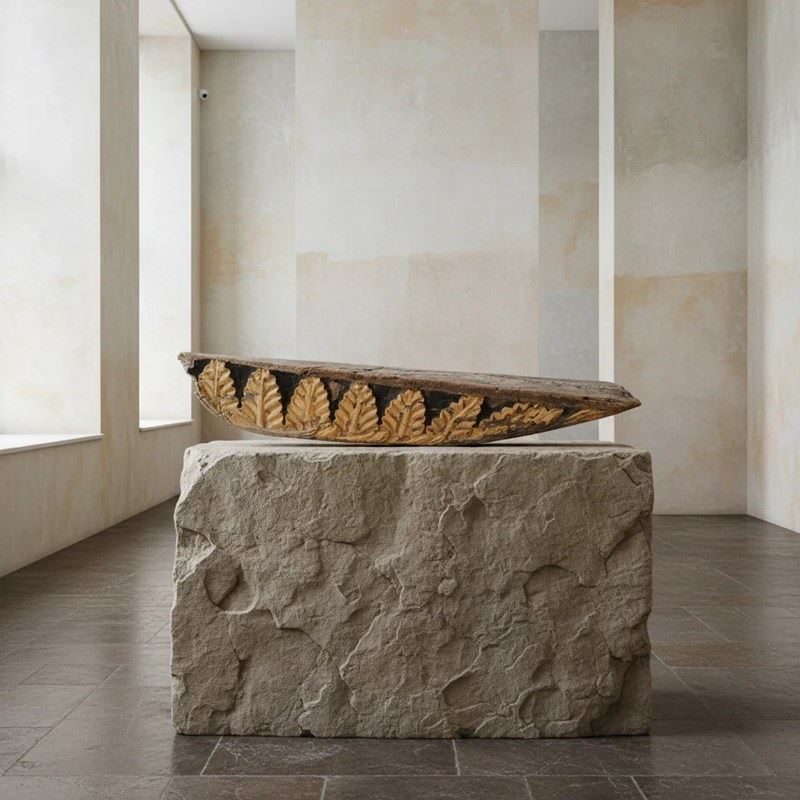
A substantial carved fragment in English oak, originally taken from a British naval warship during the period c.1790–1810.
The deep, rhythmic carving presents a bold repeat of stylised acanthus leaves, the classical motif widely used across the decorative upperworks of Royal Navy vessels in the years surrounding the Battle of Trafalgar.
Acanthus ornament was the standard language of carved naval decoration in this era, appearing on stern fascias, quarter galleries and bulwark friezes. Here the leafwork is finished in a distinctive peach-toned paint layer over a darker ground — a palette consistent with painted ship ornament designed to stand out against the black hull and catch shifting light at sea.
The surface—layered with age, pigment wear and salt-softened texture—suggests long service before the piece was reputably dislodged in combat, or removed when the vessel was later broken up. The gentle, hull-like curve and the exposed, weathered grain all reinforce its maritime character.
A powerful sculptural fragment with exceptional historical presence — a rare survivor from the era of Nelson and the great British ships-of-the-line.
British, English oak, c.1790–1810.
Width: 172 cm (67.72″)
Height: 37 cm (14.57″)
Depth: 48 cm (18.9″)
- Period: C.1800
-
- Price: £4,950.00
- €5,851 Euro
- $6,559 US Dollar
- Location: Yorkshire
-
- Dimensions: H: 37cm (14.57in)
- W: 172cm (67.72in)
- D: 48cm (18.90in)