Decorative Collective - www.decorativecollective.com
Sellers's Details
DOE AND HOPE
Tel:
Email: [email protected]
https://www.decorativecollective.com/dealers/doe-and-hopeItem Details
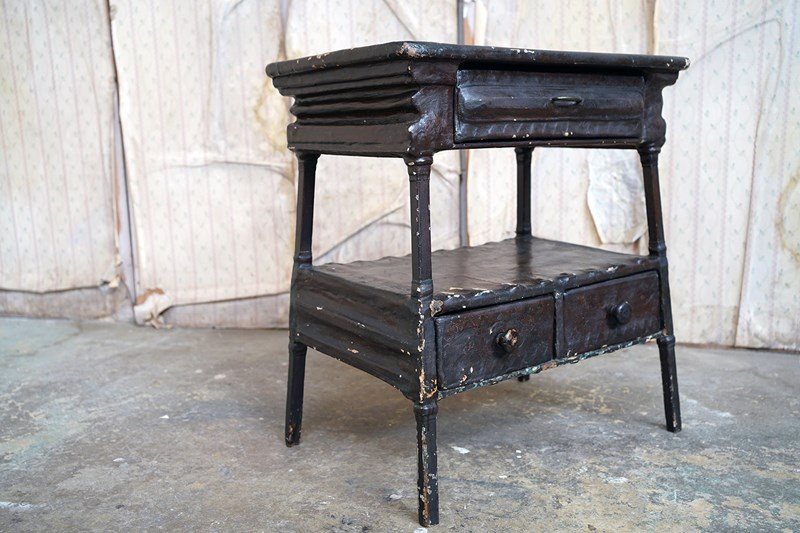
The remarkable mid-nineteenth century folk art side or work table of rectangular form, with a top centred by an incised quatrefoil motif to a dogtooth border to concertinaed sides flanking a frieze drawer with brass handle above an open crimped edge under tier and two lower drawers, the whole raised on slender turned supports and retaining a richly worn dark chocolate coloured japanned surface throughout, the reverse frieze boldly moulded with the inscription ‘BETTY NIELD AGED 70 1853’, the carcass constructed using layers of period manuscript and copybook papers beneath the surface finish, and offering a fascinating glimpse into vernacular craftsmanship and domestic life during the early Victorian period.
The table possesses an honest, untouched character, its worn surface and utilitarian form combining to create a striking decorative object with considerable visual appeal. She remains in unrestored condition, displaying expected wear, losses and surface abrasions consistent with age and use. Areas of the underlying paper construction are visible to the underside and interior, revealing handwritten copybook exercises, manuscript fragments, copperplate writing exercises, biblical texts and printed engravings including illustrations relating to Crystal Palace and the Great Exhibition of 1851, all incorporated into the manufacture of the table. Since the latest identifiable printed material dates from 1851, and the frieze is carved “BETTY NIELD AGED 70 1853”, everything aligns beautifully and thus it appears this piece was almost certainly made around 1853, using contemporary waste paper, rather than later restoration material which is a remarkable piece of evidence.
Named and dated vernacular furniture of this nature is increasingly difficult to find as furniture of this type was seldom intended to survive, making examples retaining such intimate evidence of their manufacture exceptionally scarce. The personal inscription transforms the piece from a simple item of domestic furniture into a poignant record of an identifiable individual, likely commemorating or celebrating Betty Nield upon reaching the age of seventy in 1853. Betty Nield would be aged seventy in 1853, suggesting a birth date of 1783. There is a record online for a Betty Nield born in 1783 in Bosley, Cheshire, England named as the wife of Matthew Nield, with their marriage taking place around 1810 in Macclesfield, Cheshire, England. Whether commissioned for, owned by, or commemorating its namesake, the piece survives as a tangible connection to a specific individual from the Georgian era. Particularly intriguing is the incorporation of the handwritten papers within the structure, preserving fragments of contemporary handwriting and educational exercises beneath the surface. Such details elevate the table beyond its practical purpose and into the realm of folk art and social history as the maker was using whatever was available in around 1851–53, creating what is almost a time capsule of printed ephemera from that moment in history.
Combining untouched originality, unusual mixed-media construction, named provenance and an exact date of 1853, this is an exceptional example of English vernacular folk art furniture. It possesses a wonderfully sculptural presence, rich narrative and extraordinary decorative appeal, standing as both a functional piece of furniture and a rare survivor of nineteenth-century domestic craftsmanship.
- Period: c.1853
- Sold
- Location: Buckinghamshire
-
- Dimensions: H: 28cm (11.02in)
- W: 26.5cm (10.43in)
- D: 17cm (6.69in)