Decorative Collective - www.decorativecollective.com
Sellers's Details
EARL & RYMER
Tel:
Email: [email protected]
https://www.decorativecollective.com/dealers/earl-rymerItem Details
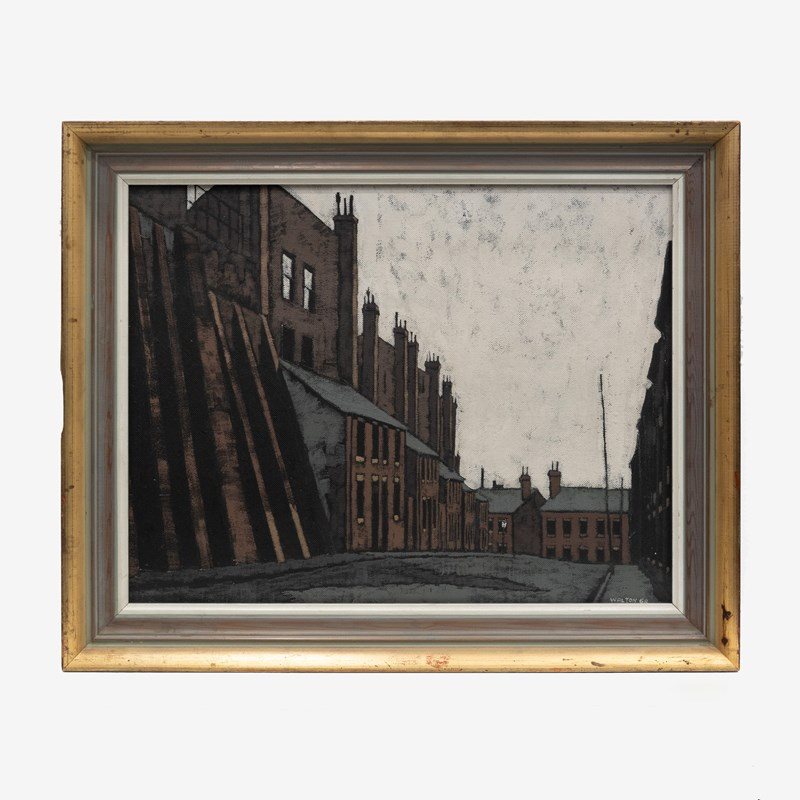
A powerful and historically significant example of mid-century Northern Realism by the acclaimed Yorkshire chronicler Stuart Walton (b.1933). Dated 1968, this imposing oil on board captures a defining, vanished moment in the industrial topography of Leeds.
The composition is dominated by a dramatic row of heavy, timber raking shores—colossal wooden buttresses erected along the slopes of, what we think may be, Mabgate to structurally brace the towering Victorian mills and foundries looming over the narrow residential streets. Characterized by Walton’s signature soot-toned palette, crisp structural line work, and atmospheric play of light, this piece serves as both an evocative work of art and an invaluable social document of a working-class community just prior to the sweeping post-war demolitions of the 1970s.
Condition: The painting itself is in very good condition, presented in its vintage frame behind glass. The frame exhibits marks and wear commensurate with age, including one notable chip out of the left-hand side measuring approximately 8cm long. In our opinion, this does not detract from the character of the piece, and the painting is ready to hang.
Frame: Height 65.5cm x Width 81cm x Depth 5cm. Painting: Height 51 cm x Width 66cm.
Born in Dewsbury, West Yorkshire, Stuart Walton is a celebrated, self-taught painter who became one of the key visual chroniclers of the industrial North. Displaying an innate artistic talent from childhood, Walton initially worked as a signwriter and display designer at Lewis’s department store in Leeds after completing his National Service with the RAF.
Throughout the 1960s and 70s, Walton became deeply compelled to document the rapidly changing landscape around him. As inner-city regeneration and deindustrialization began dismantling historic working-class neighborhoods, he took to the streets of Leeds—including Holbeck, Hunslet, and Mabgate—to paint their cobbled alleys, stark gas lamps, and imposing brick mills before they were lost forever.
His exceptional mastery of form and light brought him widespread recognition, culminating in his appointment as the inaugural Yorkshire Television Fine Arts Fellow in 1975. Today, Walton’s mid-century urban landscapes are highly prized by collectors for their raw authenticity and seamless integration into modern, mid-century interior design aesthetics. His works are held in prestigious public institutions, including The Hepworth Wakefield and the Walker Art Gallery, Liverpool.
- Period: Dated 1968
-
- Price: £1,450.00
- €1,713 Euro
- $1,918 US Dollar
- Location: Yorkshire
-
- Dimensions: H: 65.5cm (25.79in)
- W: 81cm (31.89in)
- D: 5cm (1.97in)