Decorative Collective - www.decorativecollective.com
Sellers's Details
GEORGIAN ANTIQUES
Tel: +44 (0)131 5537286
Email: [email protected]
https://www.decorativecollective.com/dealers/georgian-antiquesItem Details
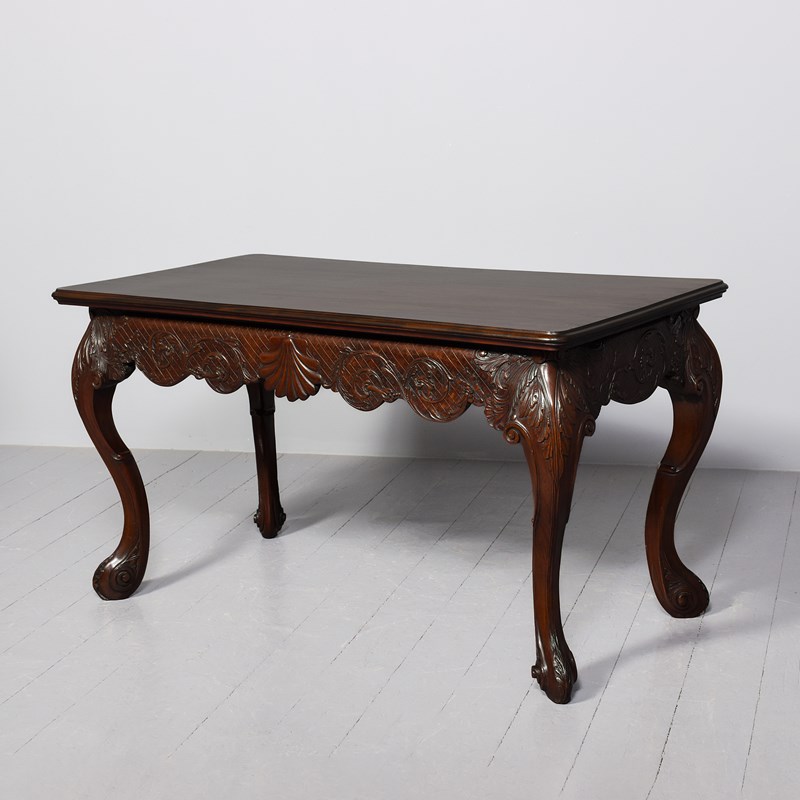
Circa 1880. Outstanding Irish Chippendale style consul table in the manner of Hicks of Dublin. The single-piece rectangular top, with moulded edges on all sides in a quality figured Spanish mahogany. The classical Irish deep frieze with a central shell and rococo foliate decorations, and supported on fluted cabriole legs with bold acanthus carved knees terminating in acanthus decorated scrolled toes. The sides with matching decorated skirts, and the rear legs (unusually) of similar bold construction to the front legs. The antique wood mahogany top (possibly originally had a marble top) has been traditionally restored.
James Hicks was born into a family of Dublin chair-makers and was trained in London in the cabinet-making workshops on Tottenham Court Road. On his return to Dublin, he set up businesses in Lower Pembroke Street in 1894 and established what was to become one of the city's leading cabinet-making firms. His clients included Princess Victoria, the Crown Princess of Sweden, and King Edward VII. The firm specialised in high-quality copies of pieces in the styles of Sheraton, Hepplewhite and Chippendale as well as pieces in the style of the prominent 18th century Dublin cabinetmaker and marqueteer William Moore. Hicks described himself as a 'Cabinet Manufacturer, Collector and Restorer of Chippendale, Adam and Sheraton furniture'
His early furniture reflected the 18th century Palladian style, featuring decorative shells, acanthus leaves, laurel swags, and heavyset cabriole legs. Later work was classical in style and refined. Hicks won many awards - notably the Aonach Tailteann in 1928. His satinwood display cabinet won a silver medal at the Royal Dublin Society Spring show in 1934 and was one of several pieces which represented Ireland’s craftsmanship at the New York World Trade Fair in 1939. The President and Chairman of the fair sent a certificate to the Hick’s firm conveying their appreciation of the substantial contribution which Hick’s exhibit had made towards the success of the fair. Hick sadly died in 1936, never gaining the opportunity to receive this accolade in person.
- Period: Circa 1880
-
- Price: £3,950.00
- €4,659 Euro
- $5,213 US Dollar
- Location: Scotland
-
- Dimensions: H: 76cm (29.92in)
- W: 140cm (55.12in)
- D: 72cm (28.35in)