Decorative Collective - www.decorativecollective.com
Sellers's Details
LOVEDAY
Tel: +44 (0)1438 869819
Email: [email protected]
https://www.decorativecollective.com/dealers/lovedayItem Details
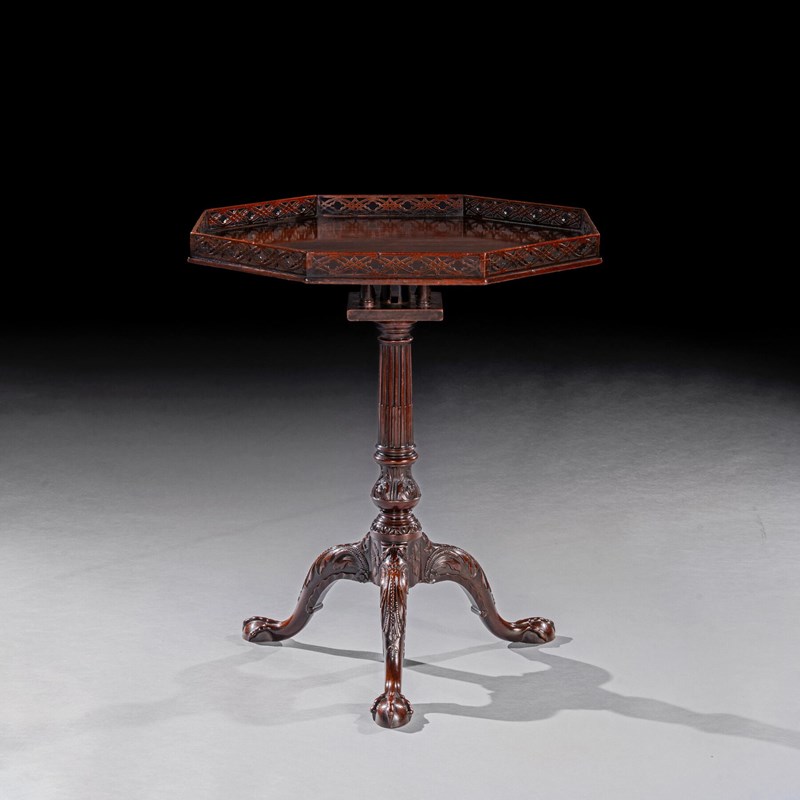
Extremely Fine and Rare George III Mahogany Octagonal Tripod Table With Extensive Provenance.
English c.1760
Provenance
J. Rouse esq., c.1916
Acquired from either Trevor Antiques of Brighton or Charles Woollett and Sons of Wigmore Street, London, c.1950
A private collection
Christie's London, 1999
A New York private collection
Sold at Christie's New York, 18th of October 2005, lot 390 ($66,000)1600-
Aso Tavitian
With a bird cage mechanism allowing the top to be rotated and tilted, this fine table is of octagonal shape with a laminated gallery. The pattern of fretwork used for the gallery is very unusual and is not one of the designs published in the 18th century by the likes of Crudden, Chippendale or Darly and so suggests that it was probably invented in-house by one of the great cabinetmakers of the period. Tripod tables have long been regarded as one of the most prized of all pieces by serious collectors of English furniture and those with laminated fretwork galleries are particularly sought-after, reflecting as they do the fascination with chinoiserie and the rococo in the middle of the 18th century in England.
The present table has a finely carved stem with stop fluting leading down to two ring mouldings above a baluster section with acanthus carving. Another succession of rings follow to an egg and dart moulding above the three downswept legs, all profusely carved with acanthus leaves and beading topped with bell flowers, with each leg terminating on a strongly defined claw and ball foot.
The top block bearing a depository table FREDK.FISH & SON,/DEPOSITORY,/IPSWICH with a pencil inscription Mr Rouse/No.15/March 14.16
The present piece is closely comparable to a table once owned by the great dealers Norman Adams Ltd and illustrated in the book British Furniture 1600-2000. The design of the piece is extremely sophisticated, the octagonal top an uncommon feature and a highly attractive one, especially when combined with the fretwork which is laminated with the grain in opposite directions for added strength. Tables of this sort were commonly thought of as tea tables in the 18th century and would have been used in conjunction with a kettle stand with comparable decoration when new. A visit to a collection such as that of the late Noel Terry now housed in Fairfax House in York reveals tables of comparable quality, collected in the early 20th century at the same time as the present piece was in the collection of the mysterious "J. Rouse", his name indicated on a depository label attached to the reverse of the piece along with the date of 1916.
The present table has been in the collection of one of the leading connoisseurs of English furniture in the late 20th century, Mr. Aso Tavitian, as well as having been handled in the mid-20th century by either Woollett and Sons or Trevor Antiques, both leading dealers of the time.
Dimensions
Width 26 inches - 66cm
Height 30 1/2 inches - 77.5cm
Depth 26 inches - 66cm
- Period: Circa 1760
-
- Price: £29,500.00
- €34,872 Euro
- $39,090 US Dollar
- Location: Hertfordshire
-
- Dimensions: H: 77.5cm (30.51in)
- W: 66cm (25.98in)
- D: 66cm (25.98in)