Decorative Collective - www.decorativecollective.com
Sellers's Details
WALPOLES
Tel: +44 (0)207 7275263
Email: [email protected]
https://www.decorativecollective.com/dealers/walpolesItem Details
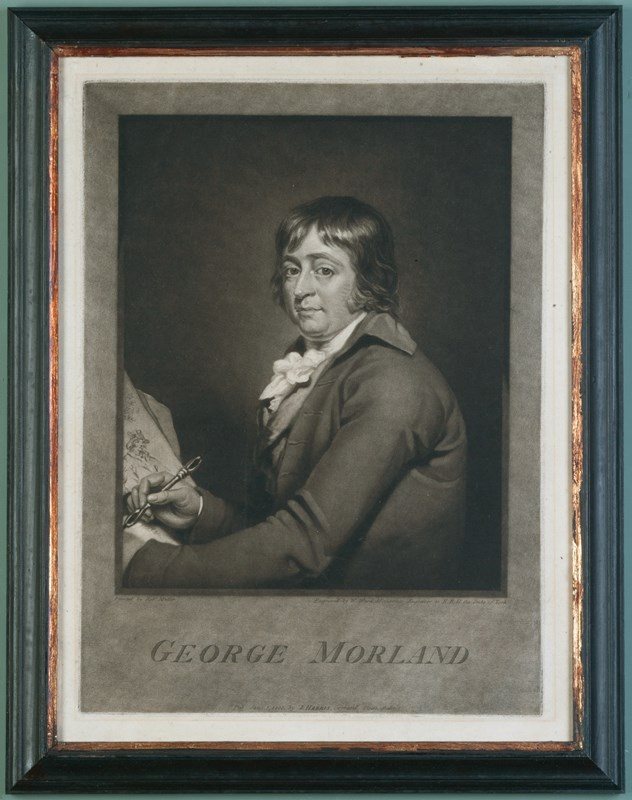
A good mezzotint engraving by William Ward of the artist George Morland, after the portrait painted by Robert Muller.
Within a good replica of an eighteenth century print frame, ebonized and with a gilt sight. 14 5/8 in x 18 5/8 in
George Morland was born in London in 1763, son of Henry Robert Morland and grandson of George Henry Morland. By the age of ten he was an honorary exhibitor of sketches at the Royal Academy. He exhibited at various societies until 1777 and was back again at the RA in 1778, 1779 and 1780. Under the strict tutelage of his father he was encouraged to make copies of pictures of all kinds but especially those of the Dutch and Flemish masters.
Morland was a heavy drinker who was soon to follow a dissolute life-style, becoming a victim through friendship of his many agents. Towards the height of his powers, during the 1780’s, he was able to leave the exploitative agent with whom he was lodging, making a dash for Margate, and after a short while, on to France where he was kept busy with commissions from those who had heard well of him. He returned to London before the 1780’s were out, lodging at a house in Kensal Green.
He was soon married to the sister if his friend, the engraver William Ward, (who engraved this portrait), and who in turn, was soon married to George’s sister. After just three months, this double household fell apart following arguments between the sisters-in-law. The Morlands moved to Camden Town, a small house in Pleasing Passage. The short break from the bad company of ostlers, potboys, horse jockeys, moneylenders, pawnbrokers, punks, and pugilists came to an end with all falling under the influence of the local inns and the Assembly Rooms of Kentish Town. Following the death of their child and the protracted illness of his wife Anne…….George left home for Paddington. He did, however, make her an allowance, for as long as he lived, which transpired not to be for too long.
Much of Morland’s output was done to be engraved and printed, and over the course of his short life he is estimated to have painted at least four thousand pictures. Between 1788 and 1792, at least a hundred of George’s paintings were engraved and successfully published. In total around 250 engravings of his works were produced.
Towards the end of 1799 Morland was at last arrested for debt but allowed to take lodgings, ‘within the rules’. Here he was pursued by the worst of his ‘friends’ and often found to be drunk for days on end, in a helpless state asleep on the floor. On the 27th October, 1804, George Morland died in a sponging-house in Eyre Street, Cold Baths Fields. His wife died three days later. They are buried together in the burial-ground attached to St. James’s Chapel in the Hampstead Road.
- Period:
-
- Price: £485.00
- €575 Euro
- $643 US Dollar
- Location: London