Decorative Collective - www.decorativecollective.com
Sellers's Details
WALPOLES
Tel: +44 (0)207 7275263
Email: [email protected]
https://www.decorativecollective.com/dealers/walpolesItem Details
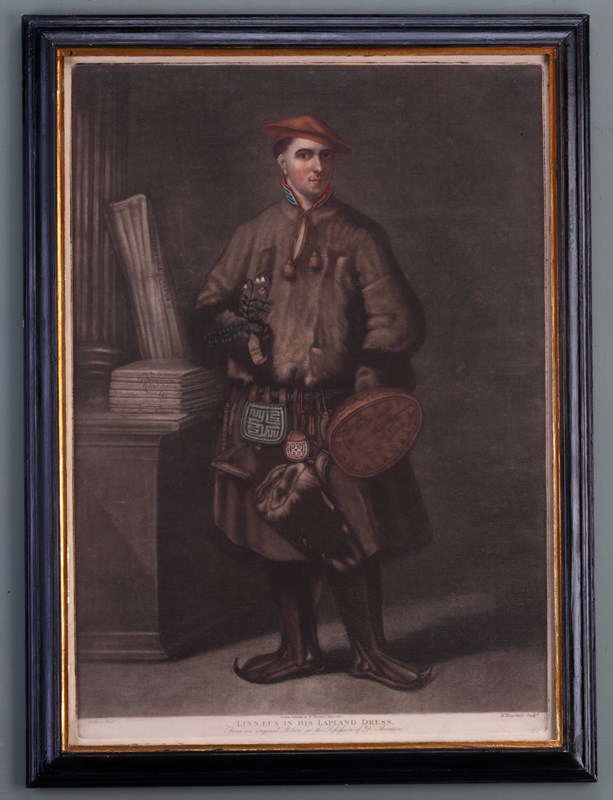
A fine mezzotint printed with colour, "Linnæus in his Lapland Dress”. Published in 1805 in Dr. Robert Thornton’s New Illustration of the Sexual System of Carolus von Linnaeus.
Linnaeus is shown to us holding a favourite plant, the twin flower, identified on a label Linnaea Gronovius. As part of his Laplander dress, Linnaeus is holding a Shaman’s drum inscribed around the top edge "Carolus Linnæus a Lapponia redux aetat 30, anno 1737" ("Carl Linnaeus home from Lapland, aged 30, 1737”) and around the lower edge; "Mart Hoffman fecit”. The title line states that this print has been published in London by Dr. Thornton, June 1st 1805 “From an original Picture in the Possession of Dr. Thornton”, painted by Hoffman and engraved by Kingsbury.
Carl Linnaeus (1707-1778) was a Swedish zoologist, botanist, and taxonomist. He invented the binomial nomenclature, a formal system classifying the natural world and still in use to this day.
Framed within an excellent copy of an eighteenth century print frame, the ebonized moulding with a thin gilt sight edge. o.s:16.75 inches x 22.5 inches
In 1732, Linnaeus travelled to Lapland, a province in Northern Sweden, to find new plants, animals, and minerals. He was also interested in studying the culture of the Sámi people who are indigenous to the northern parts of Norway, Sweden, Finland, and the Russian Kola Peninsula. This portrait shows him wearing elements of traditional Sámi winter clothing made of reindeer skin and fur, and holding a Sámi shamanic ceremonial drum, an important part of the Sámi peoples’ pre-Christian religion, it helping the shaman to enter a state of trance and further served as an instrument to foretell the future. Since first encounters of the Sámi people with the outside world efforts have been made to take by force Sámi artefacts on the pretence of preserving an allegedly disappearing and ‘exotic’ culture. The drums were considered a threat to the Christian mission and so they were either burned or collected and sent to museums around the world.
- Period:
-
- Price: £1,050.00
- €1,223 Euro
- $1,396 US Dollar
- Location: London