Decorative Collective - www.decorativecollective.com
Sellers's Details
WILLIAM AVERY FINE ART
Tel:
Email: [email protected]
https://www.decorativecollective.com/dealers/william-avery-fine-artItem Details
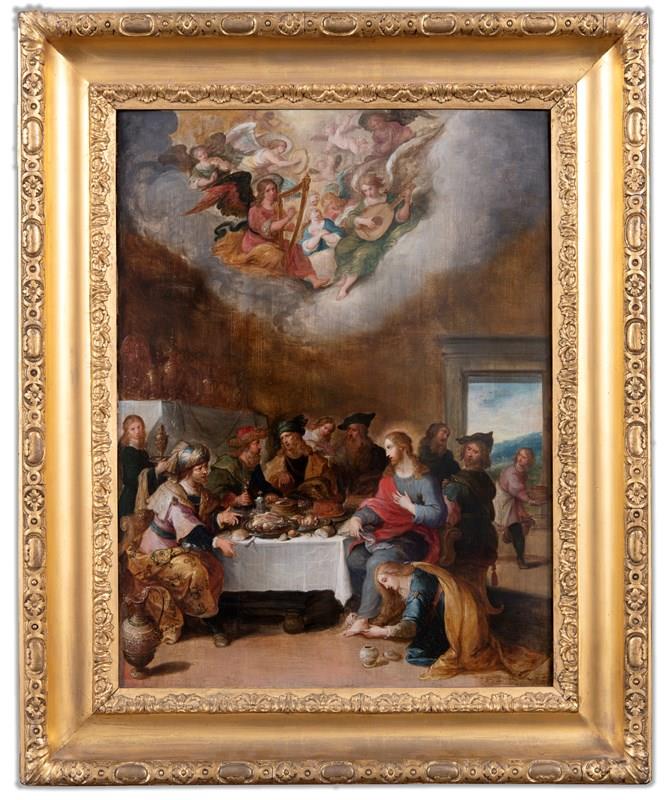
Christ in the House of Simon the Pharisee
Frans Franken the Younger. Signed lower right “D.o. ffranck IN et f”
Frans Franken the Younger (1581- 1642) is the pre-eminent artist of the Francken Dynasty of Painters, whose activity spans from the mid-16th Century to the late 17th Century. His paintings are in the collections of leading museums worldwide, including the National Gallery (Washington, DC) the Getty (Los Angeles), the Prado (Madrid), the Rijksmuseum (Amsterdam) and the Louvre (Paris).
This signed painting is entirely new to the art market and has a sterling provenance. It has been part of an English noble family collection for at least the last 250 years, having been acquired for the collection of Kings Weston House in the 18th Century; it appears in the 1777 inventory of goods from the house.
Our painting is a major new discovery, and a new addition to the Frans Francken the Younger oeuvre. It appears to have been mis-identified as a work by Francken’s father, also Frans Francken: a handwritten label on the rear lists attributes the painting to “F. Francken (1544 – 1616).” These are Frans Francken the Elder’s birth and death years. However, the work is clearly in the style of the younger Francken, and the signature matches perfectly signatures on known works by the younger Francken.
The error is an understandable one, as the signature says “D.o. ffranck,” “D.o.” standing for the Flemish “de oude,” which means the Elder. Why, then, did the Younger Francken sign his paintings the Elder? Well, the Younger did so only after his own father died; by that time the Younger was a father himself, and now himself the Elder. (Of course, his son Frans III (1607 – 1667) also became a painter, further confusing matters, but did not achieve anywhere near the prominence of his father.)
The subject of our painting has also been misunderstood over the years. It is not, as the label on the reverse says, “The Lords Supper,” although Christ is present and it is a Supper. The Kings Weston House inventory of 1777 is closer to the mark, with “The Washing of Our Saviour’s Feet.”
The subject of our painting is in fact the episode from the Gospel of Luke (7:36-50) where Christ dines at the House of Simon the Pharisee. There Christ’s feet are anointed by a sinful woman, who came to the House when she heard Christ would be present.
The composition is in two halves, heaven above and earth below. In the lower part is Simon’s elaborate dinner table, with the host on the left, Christ on the right and other guests in the middle, as severs work busily in the background. Simon is dressed in glorious finery, rendered in exquisite detail by Francken. Christ, of course, is dressed in a simple tunic; a halo surrounds his head and his eyes are locked on Simon’s, as the two are evidently in intense discussion.
They are talking about the woman kneeling at Christ’s feet, and more generally about sin and God’s forgiveness: “And he turned to the woman, and said unto Simon, Seest thou this woman? I entered into thine house, thou gavest me no water for my feet: but she hath washed my feet with tears, and wiped them with the hairs of her head.” (Luke 7:44)
Francken has painted this episode with tender creativity, while being faithful in every detail to Luke’s account. We see her tears in mid-air, falling from eyes reddened by crying. We see her wiping Christ’s feet with her long blonde hair. And we see before her the open jar of ointment she is using, along with her precious tears, to anoint Christ’s feet.
Hands are feet are among the most difficult things to paint well. Rarely in Renaissance painting do we find two hands wrapped around a foot, and Francken has executed the trio with masterful precision.
Luke ends his account with Christ telling the woman, “Thy faith hath saved thee; go in peace” (Luke 7:50). His words bring us to the upper part of the canvas, the heaven that awaits those who have faith and love.
Francken’s heaven is a place of peace, with putti and Angels floating serenely above the table. One Angel plays the lute, another the tambourine and a third plucks a harp; the angelic harpist stares out at us from the canvas, quickly catching our attention. Francken, however, has arranged the heavenly figures in an inverted pyramid, gently directing our gaze back down to the main scene on earth.
The Heaven Above motif is one found in several other Francken paintings, including his “Mankind's Eternal Dilemma: The Choice Between Virtue and Vice,” sold at auction in 2010 for a record price of €7 million.
Our painting, 400 years old yet hidden from public view for more than 250 years, now emerges again to illustrate and amplify for us this core message of Christ’s teaching, as related by Luke: “Her sins, which are many, are forgiven; for she loved much: but to whom little is forgiven, the same loveth little.” (Luke 7:47) Displaying a mastery of story-telling through paint, Francken sets forth multiple contrasts between the Simon and the sinful woman: the opulence of Simon dress and table, compared to the humility of the sinful woman; the tears pouring from the woman, a product of her love and spiritual riches, compared to the wine being poured for one of Simon’s guests, a product of his earthly riches; the winged pheasant on Simon’s table, slaughtered for temporary human sustenance, compared to the winged angels above in heaven, where those who love much – even the greatest sinners – can have eternal life.
Oil on Panel
Painted Surface: 58.4 x 44.5 cm (23 x 17.5 inches)
Framed: 78.7 x 64.8 cm (31 x 25.5 inches)
Provenance:
(Probably) acquired by Edward Southwell, MP (1705 – 1755) for Kings Weston House near Bristol. Appears in the Inventory of Kings Weston House Contents, dated 27th December, 1777 (page 26, item 4 “The Washing of our Saviour’s Feet by old Frank.”) Thence by family descent until 2024.
- Period: 17TH Century
- Sold
- Location: London