Decorative Collective - www.decorativecollective.com
Sellers's Details
WILLIAM AVERY FINE ART
Tel:
Email: [email protected]
https://www.decorativecollective.com/dealers/william-avery-fine-artItem Details
The Last Supper
Follower of Pieter de Witte (1548–1628)
View our video about this painting here.
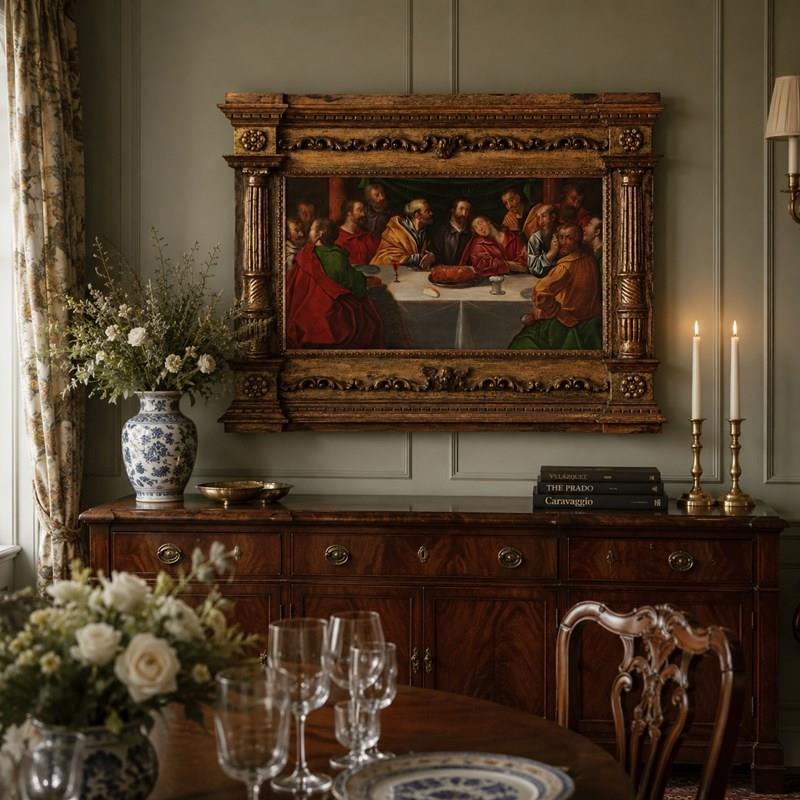
A finely composed depiction of one of the most significant moments in the Passion: the Last Supper, where Christ shares the Eucharist with his apostles for the first time, in the presence of the one who will betray him.
The composition follows a celebrated print by Pieter de Witte (also known as Pietro Candido) and Jan Sadeler I, both of whom played an important role in disseminating Renaissance imagery across Northern Europe. De Witte, born in Bruges and later Court Painter in Munich, developed several painted versions of this subject, establishing a model that influenced a wide circle of followers.
Here, the challenge of bringing together thirteen figures is handled with clarity and balance. Christ sits at the centre, calm and composed, surrounded by the apostles arranged in a vivid, almost rhythmic sequence of colour and gesture. To one side, Saint Peter appears in yellow; to the other, Saint John leans tenderly into Christ’s shoulder, conveying intimacy and foreknowledge of what is to come.
At the lower edge of the composition, Judas Iscariot is subtly set apart. Clutching a purse, he turns outward toward the viewer, his expression marked by fatigue and unease. It is a quiet but direct acknowledgement of betrayal, held within a broader scene of fellowship and ritual.
The painting is presented within a richly carved and gilded wooden frame, designed for both devotional and domestic display, reflecting its dual role as object of contemplation and visual focal point.
Provenance: Italian Private Collection
Medium: Oil on panel
Painted Surface: 42 × 74 cm (16.5 × 29.1 in)
Framed: 77 × 101 cm (30.3 × 39.8 in)
This painting is ready to hang and would make a striking focal point in both traditional and contemporary interiors. Message us for further information, including extra high-resolution images.
Worldwide shipping. Quick replies. Mayfair viewings by appointment.
Certain in situ images have been created using AI to help visualise artworks within interior settings. These representations are indicative only and may not be true to scale or proportion.
- Period: 17th Century
-
- Price: £8,500.00
- €10,150 Euro
- $11,371 US Dollar
- Location: London