
Captain John Cooke’S Family Portrait Legacy Louisa & Augusta & Sophia Devonsher
Stock No
CACL603
2023
- £5,900.00
- €6,974 Euro
- $7,818 US Dollar
Questions about this item?
Like this item?
Item Description
Historical Masterpiece Painting Captain John Cooke’s Family Legacy in Blue Oil Portrait of Louisa Cooke’s Three Daughters (c.1833)
Subject & Medium
Circle of William Egley (1798–1870), English School
Watercolour and gouache on paper laid on panel
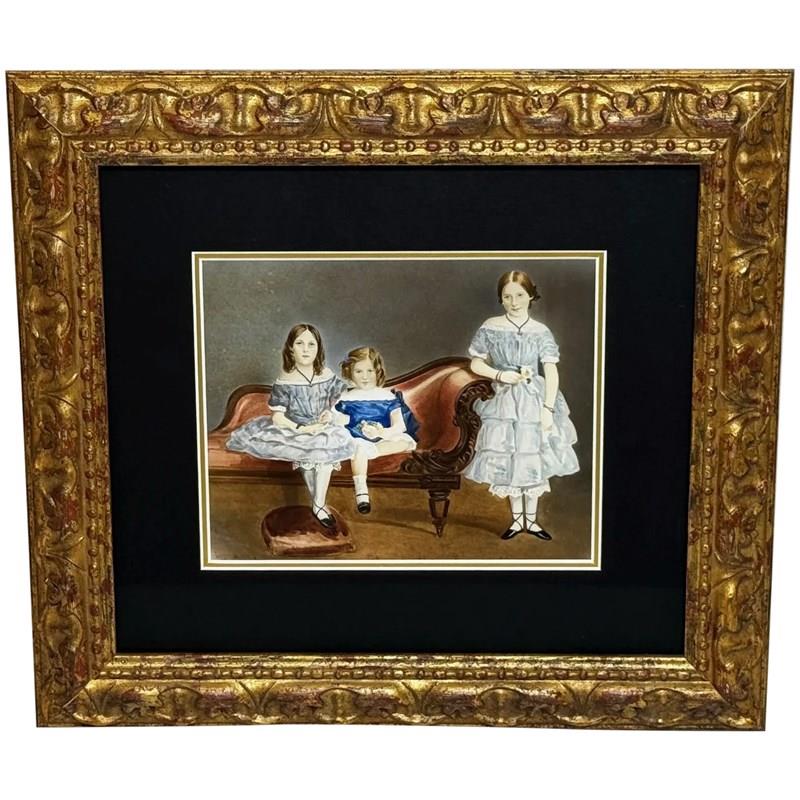
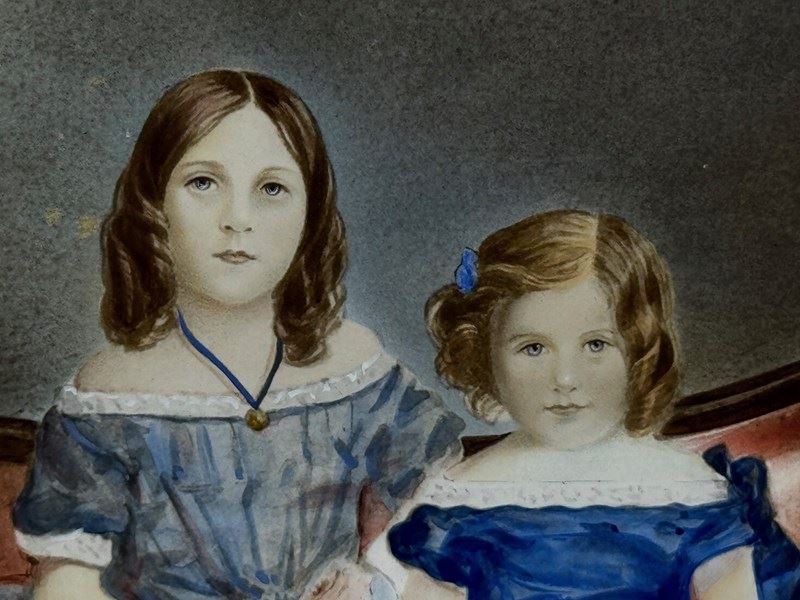
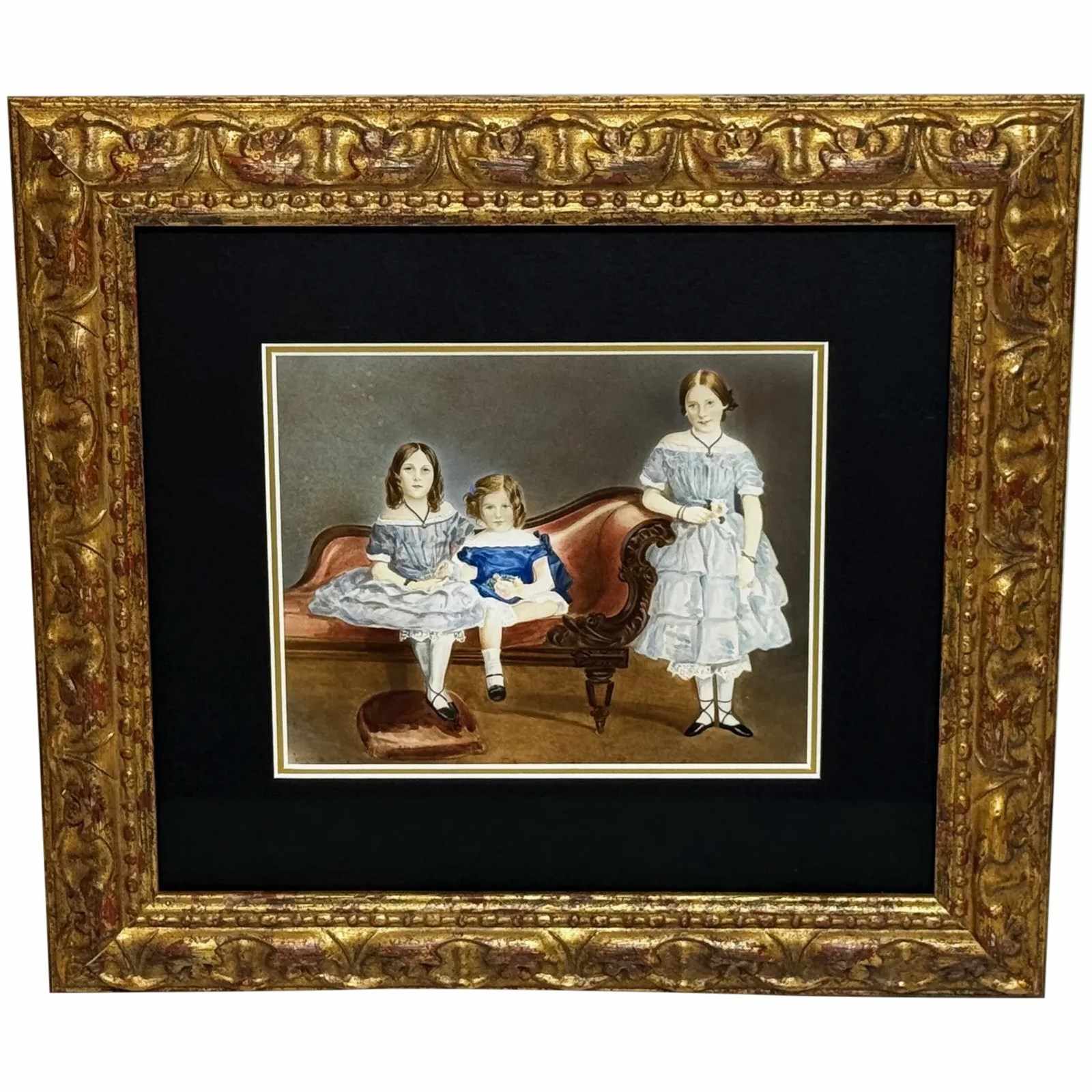
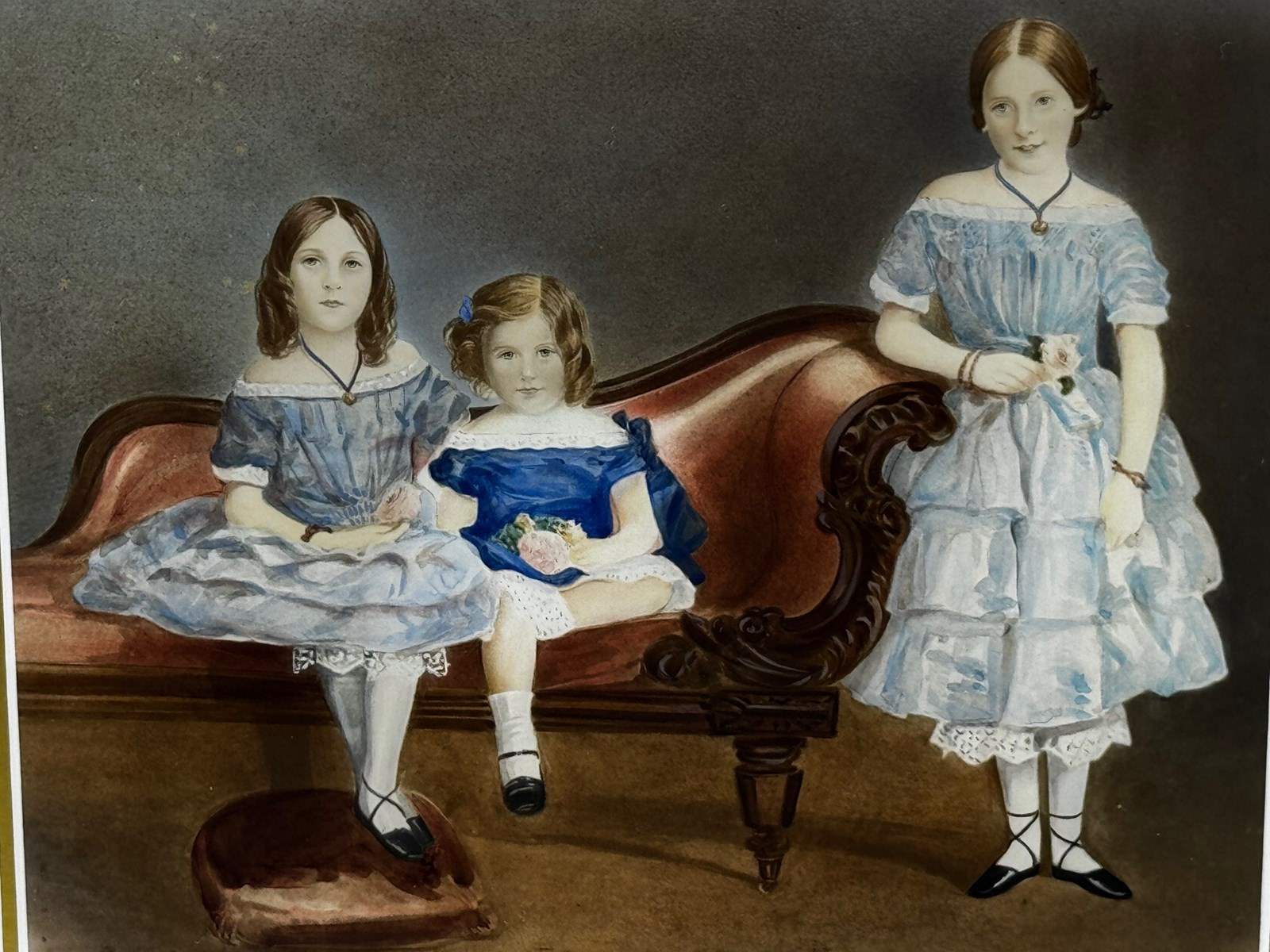
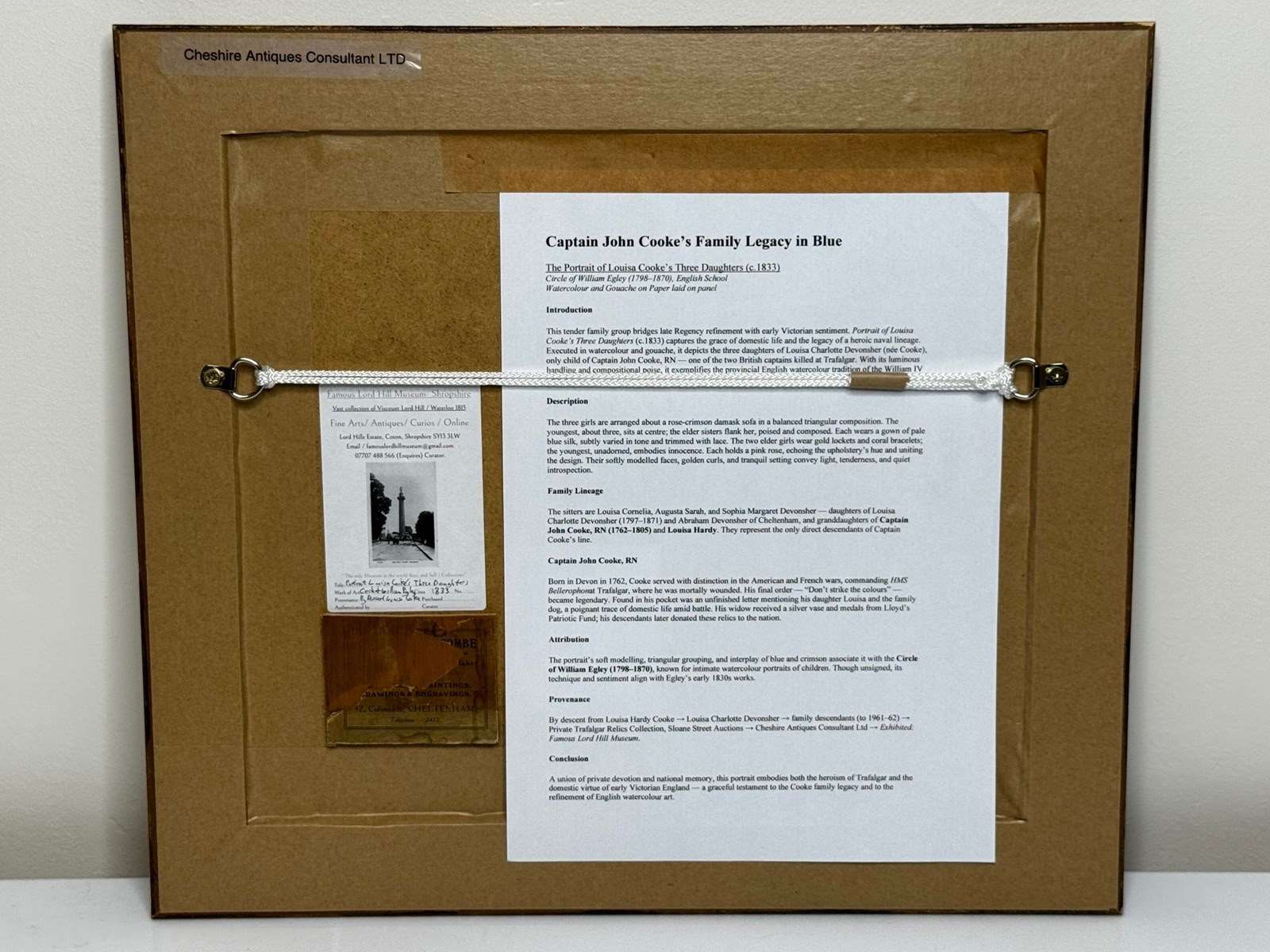
An exceptionally refined family portrait depicting the three daughters of Louisa Charlotte Devonsher (née Cooke, 1797–1871), the only child of Captain John Cooke, RN, one of the two British captains killed at the Battle of Trafalgar. Almost certainly painted for the family home, Donhead Lodge, Donhead St Andrew, Wiltshire, it is both an intimate record of domestic affection and a visual monument to one of Britain’s great naval heroes.
Composition & Technique
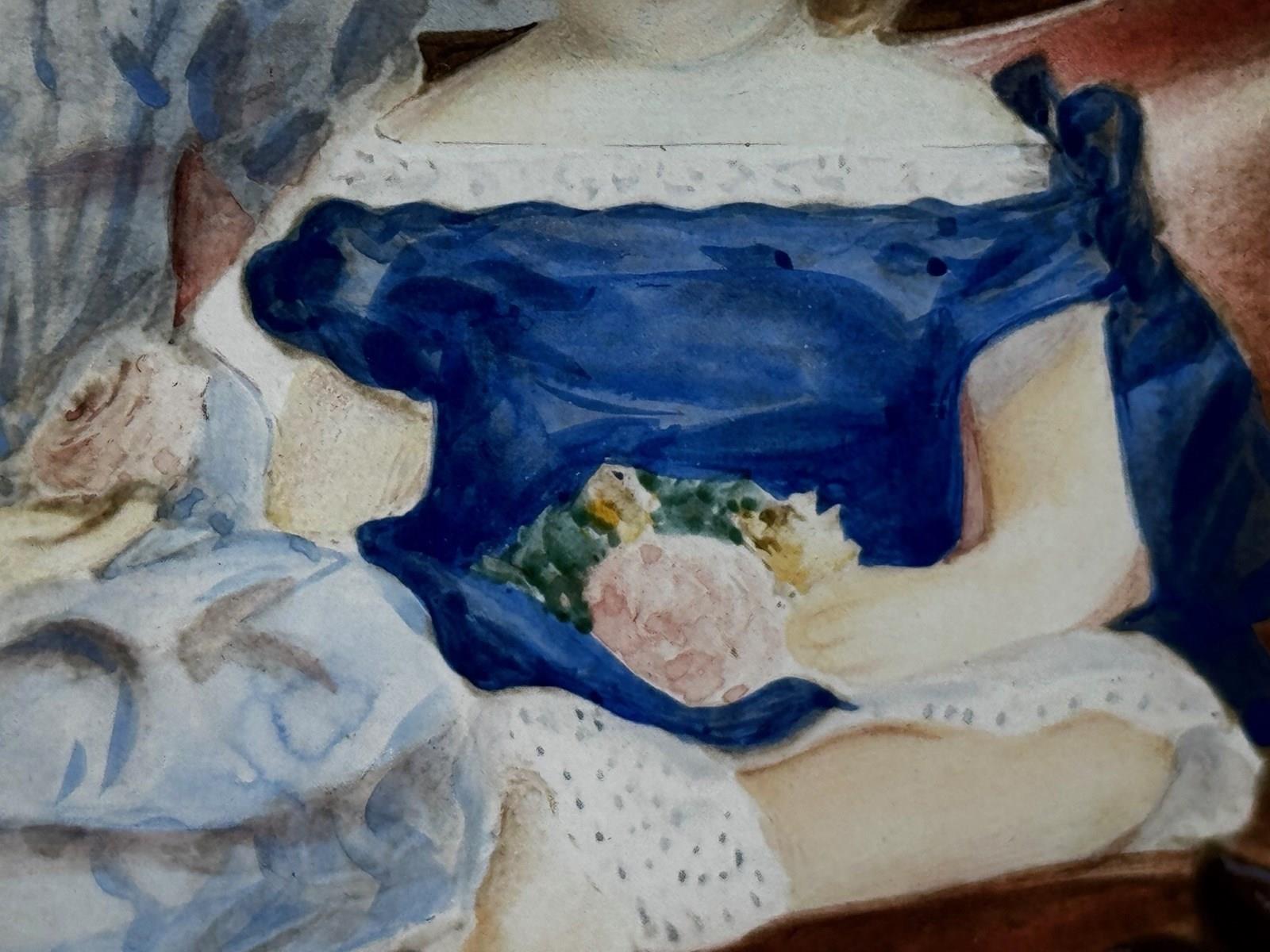
The three girls are gracefully grouped around a richly carved mahogany scroll-back sofa upholstered in rose-crimson damask, their poses forming a harmonious triangular composition.
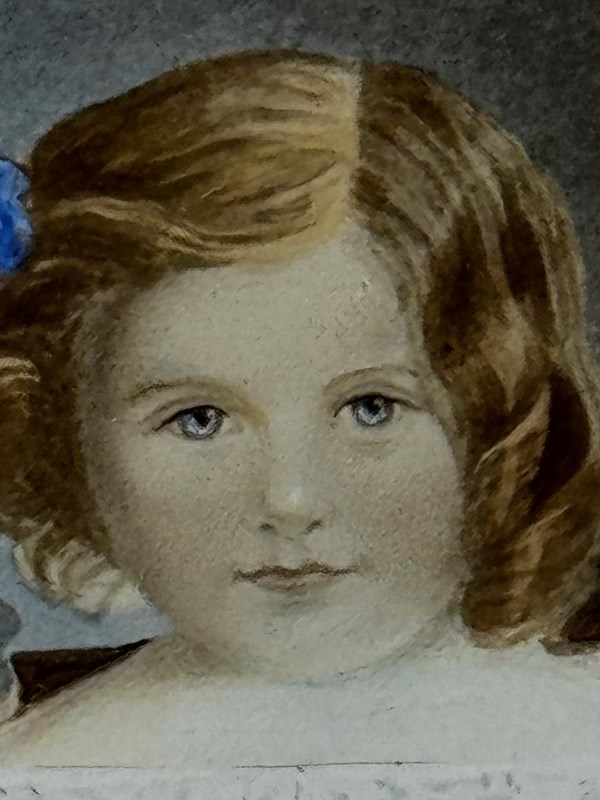
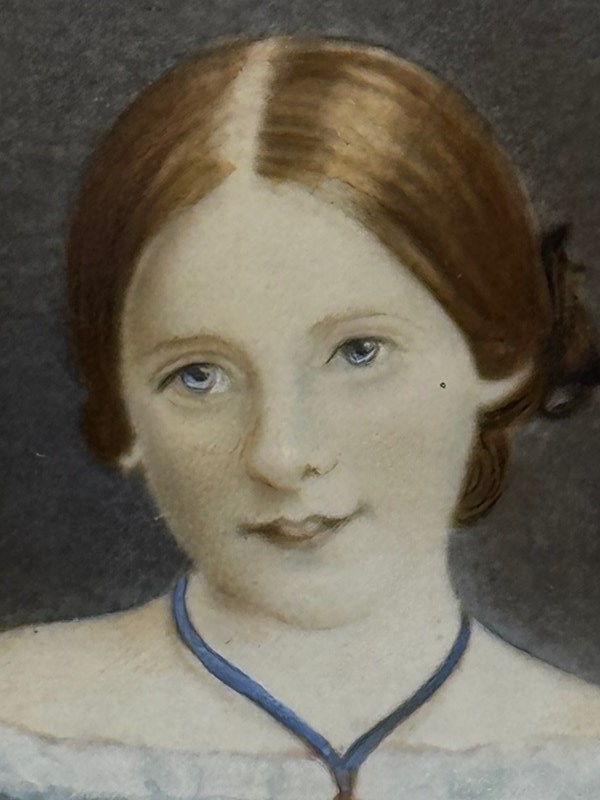
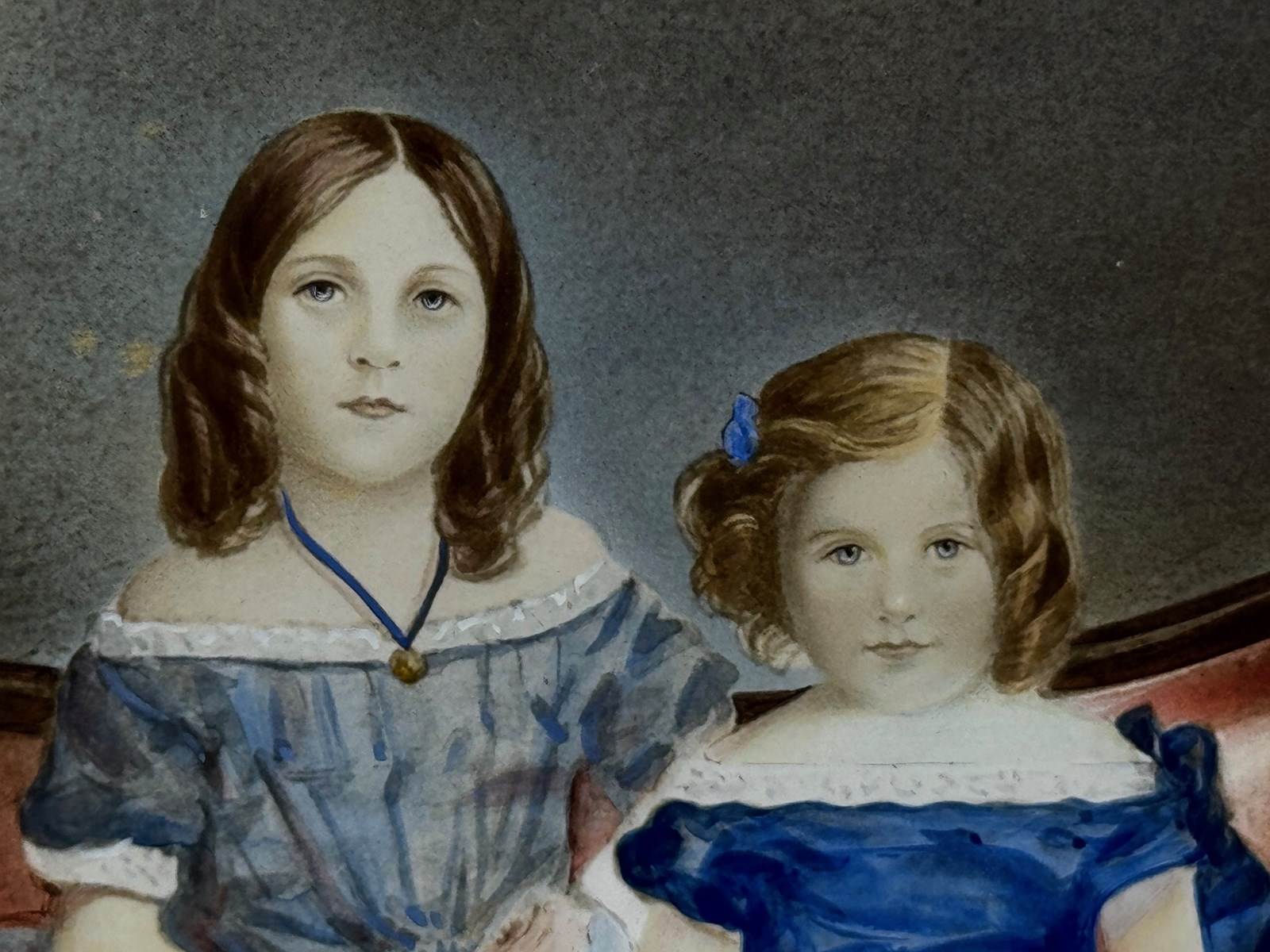
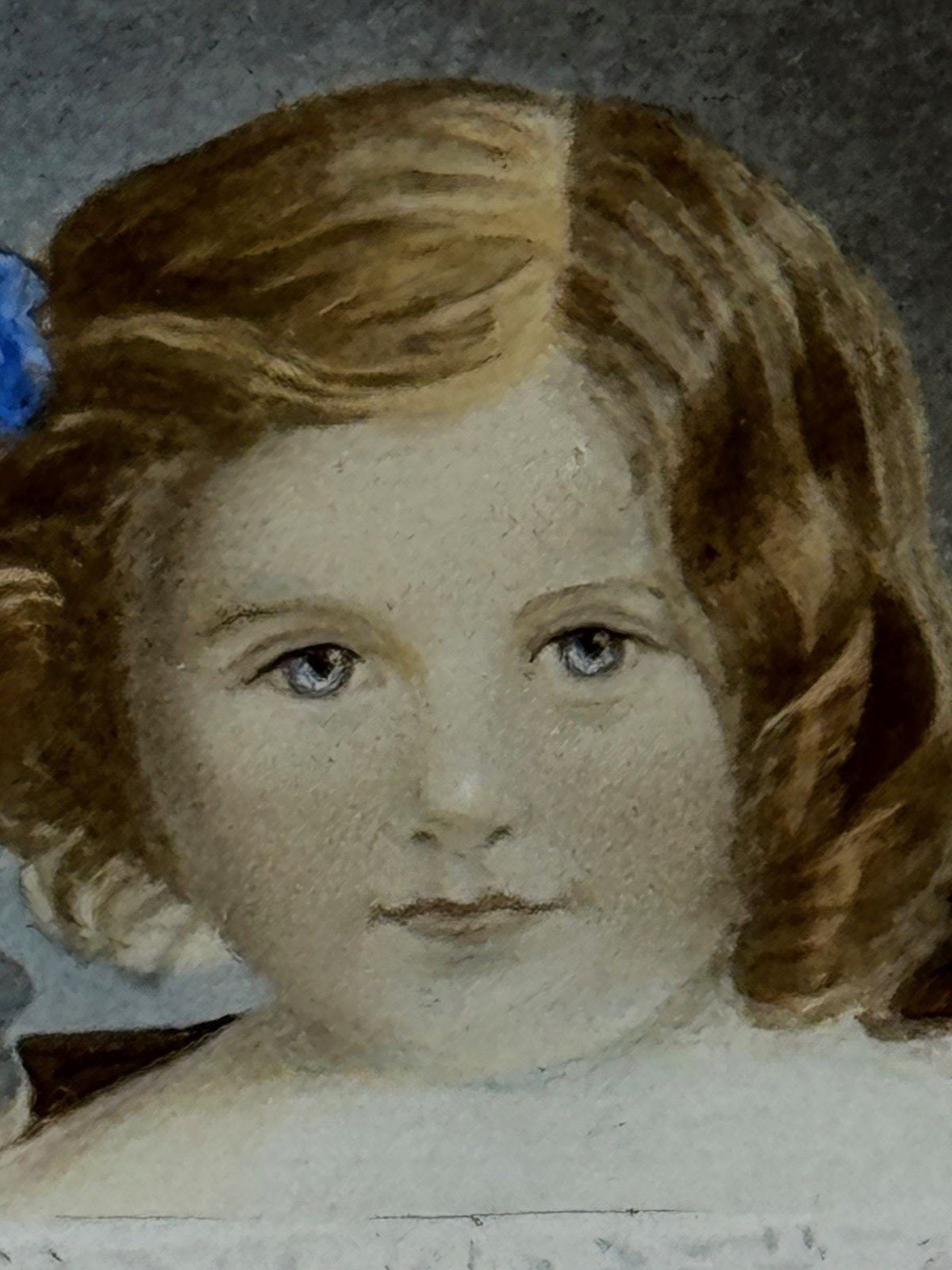
The youngest child, about three years old, sits at the centre on the sofa cushion. Her rounded features and deeper cornflower-blue gown suggest tender youth and spontaneity.
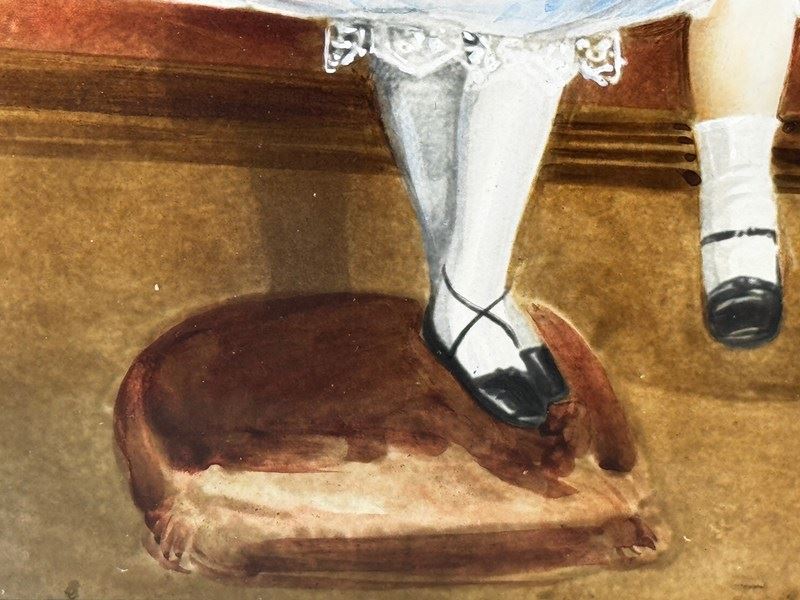
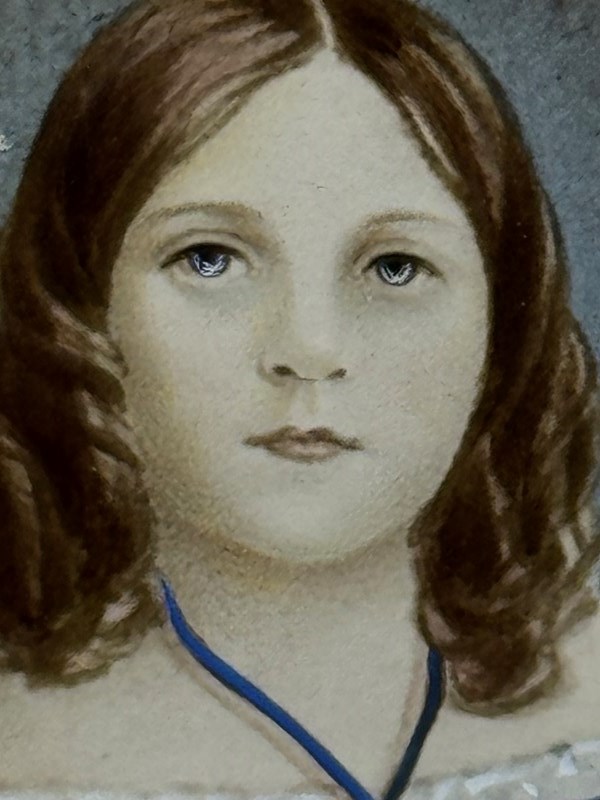
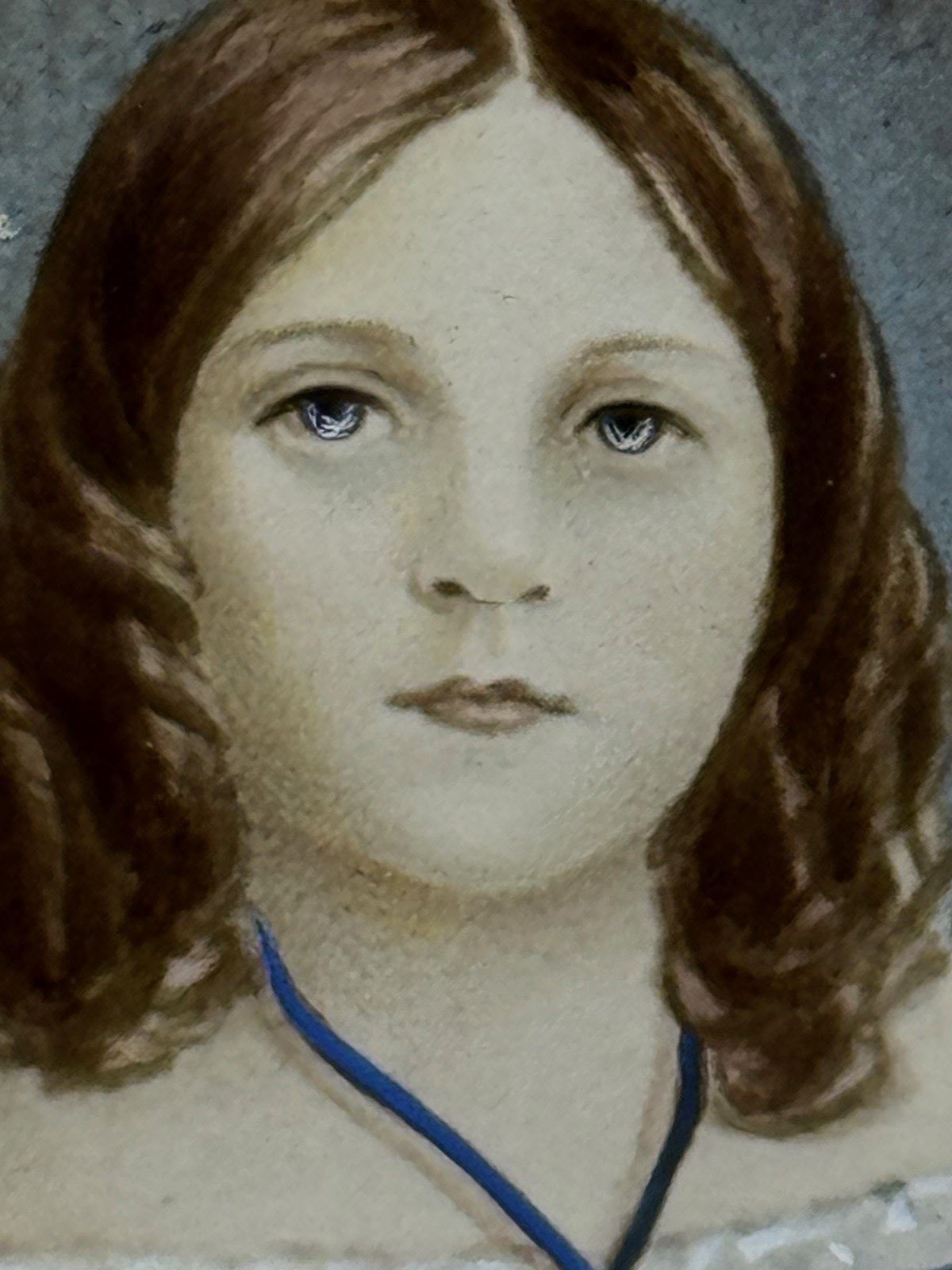
To the left, a sister of around nine or ten sits demurely, hands folded in her lap, her dress a paler sky-blue.
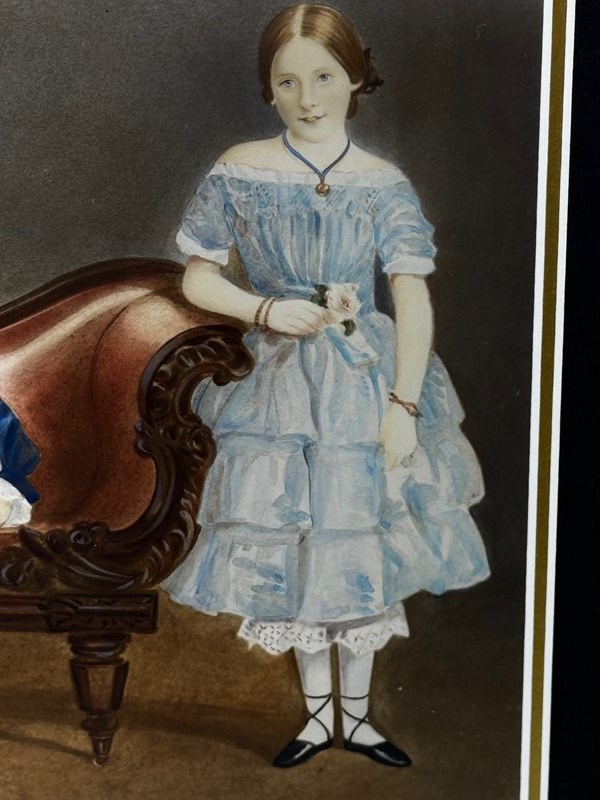
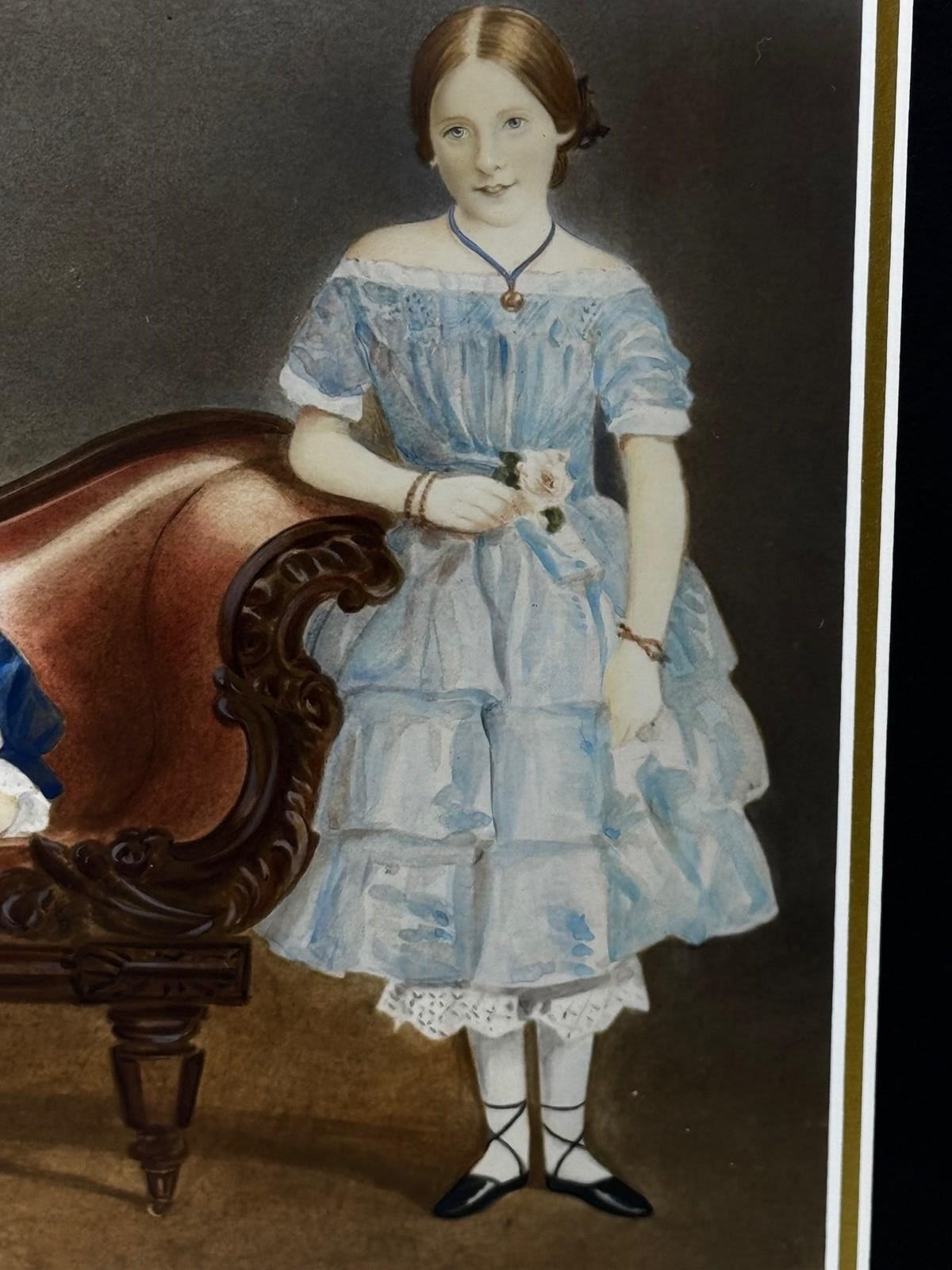
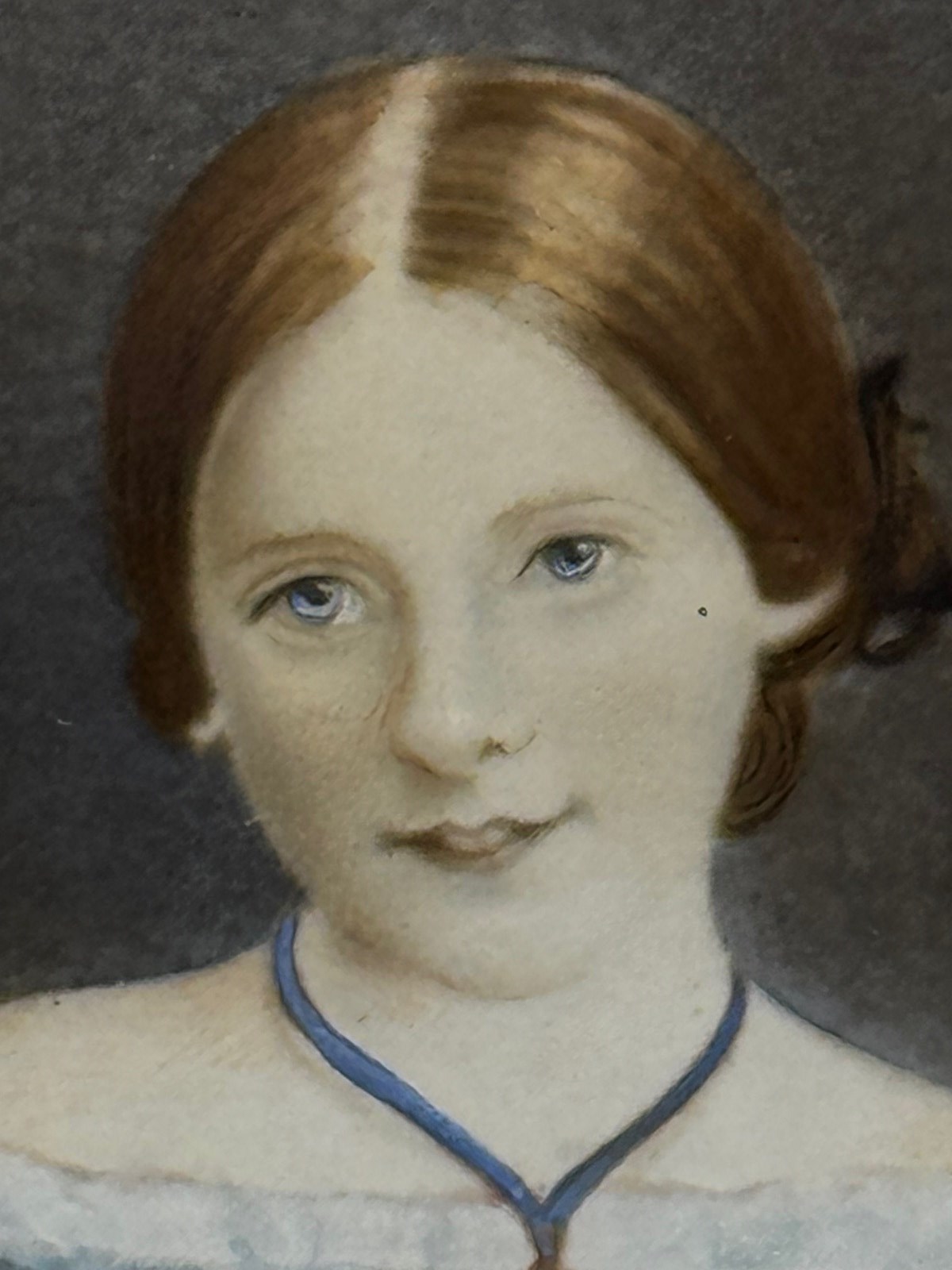
To the right, the eldest (around eleven or twelve) stands with quiet assurance at the sofa arm in a more saturated periwinkle tone, her posture gently authoritative.
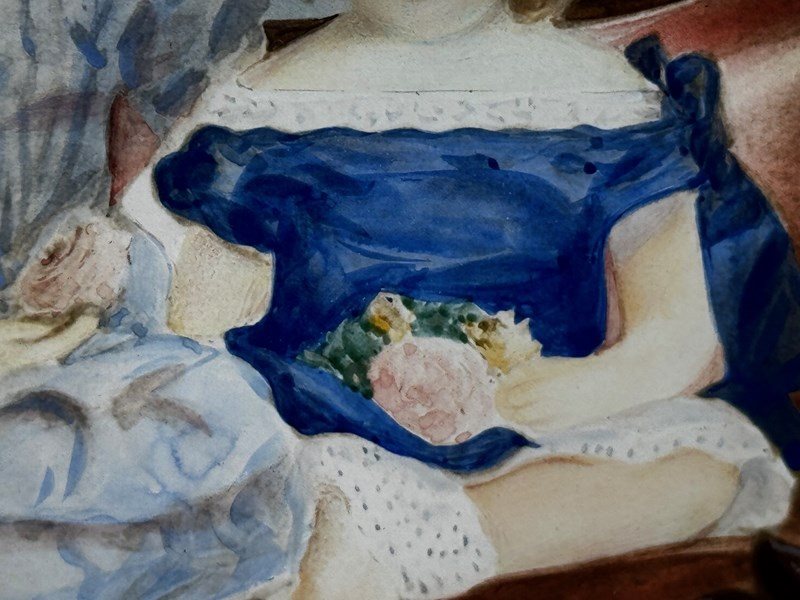
All three wear pale blue silk gowns trimmed with fine white lace. The two elder sisters are adorned with blue ribbon chokers bearing small gold lockets and coral bead bracelets, while the youngest, unadorned, embodies the ideal of unspoiled childhood. Each girl holds a blush-pink rose, the petals shaded from shell pink to soft carmine; these roses echo the crimson upholstery and visually bind the colour scheme together.
Executed in transparent watercolour with delicate gouache heightening, the artist has modelled the faces with translucent pinks and warm ochres, and the hair in chestnut and golden curls. The neutral brown-grey ground is almost abstract in its simplicity, pushing the figures gently forward and bathing them in a soft, natural light. The handling is confident yet restrained – a textbook example of the English provincial watercolour school at the transition from the late Regency to the early Victorian period.
About the Sitters & Captain Cooke
The sitters are identified as the three daughters of Louisa Charlotte Devonsher (née Cooke) and her husband Abraham Devonsher of Cheltenham:
Louisa Cornelia Devonsher (b. c.1822; later Mrs Edward Helsham)
Augusta Sarah Devonsher (b. c.1823; later Mrs Edward Rolles)
Sophia Margaret Devonsher (b. c.1830; later Mrs Robert Dwarris Gibney)
Through their mother, these girls were the granddaughters and only direct descendants of Captain John Cooke, RN (1762–1805) and his wife Louisa Hardy (1764–1853).
Born in Devon to a family of landowners and shipowners, John Cooke entered the Royal Navy under the patronage of Sir Alexander Hood and was educated at Mr Braken’s Naval Academy, Greenwich. He saw service in the American War of Independence (including the Battles of Rhode Island and the Saintes), and in the French Revolutionary Wars commanded the frigates HMS Nymphe and HMS Amethyst.
In 1805 he was appointed to the 74-gun HMS Bellerophon. At Trafalgar, on 21 October 1805, Cooke fought a fierce close-quarters action with the French ship Aigle and was mortally wounded by musket fire. He is reputed to have given the defiant order “Don’t strike the colours” as he fell – a phrase that passed into naval legend. When his body was searched, an unsent letter was found in his pocket, affectionately mentioning his young daughter Louisa Charlotte and the family dog, Mr Quiz – a poignant fragment of domestic tenderness preserved amid the carnage of battle.
In recognition of his sacrifice, Lloyd’s Patriotic Fund presented his widow Louisa Hardy Cooke with a large silver vase and a pension of £200 per annum, while Louisa Charlotte received a gold medal and a pension of £50 per annum. Louisa Charlotte later settled in Cheltenham, where she died in 1871. In the next generation, her granddaughter Caroline Augusta Rolles donated Captain Cooke’s Trafalgar gold medal and silver vase to the nation, ensuring his enduring public commemoration.
This portrait of Louisa Charlotte’s three daughters forms the private, domestic counterpart to those public honours – the living embodiment of the family line for which Cooke gave his life.
Historical Significance
This work is historically important on several levels:
A rare, fully documented image of Trafalgar’s next generation – the granddaughters of a named captain, shown in their family environment at Donhead Lodge in Wiltshire.
It embodies the early nineteenth-century cultural shift from public heroism to private virtue: the hero’s courage at sea balanced by the moral and domestic calm of his descendants at home.
With its direct connection to Lloyd’s Patriotic Fund awards and to the later donation of the family’s Trafalgar relics, the picture acts as a visual bridge between battlefield, commemoration and family memory.
For collectors of maritime history, Trafalgar material, or important British family portraits, this is not merely decorative art but a primary visual document of naval heritage.
About the Artist – Circle of William Egley
Although apparently unsigned, the portrait’s refined draughtsmanship and sentiment place it confidently within the Circle of William Egley (1798–1870). Egley, a London-born painter, exhibited regularly at the Royal Academy and British Institution and was widely admired for his intimate watercolour group portraits of children and family life.
This work displays all the hallmarks associated with Egley’s circle:
Carefully balanced triangular grouping of figures
Harmonious interplay of blue dresses and crimson upholstery
Neutral, uncluttered background free from distracting detail
A subtle blend of natural observation and gentle sentiment typical of early-Victorian domestic portraiture
While prudently catalogued as “Circle of William Egley”, the quality of handling and compositional sophistication place it at a high level within that orbit.
Signature & Attribution
Apparently unsigned on the visible surface. Offered as “Circle of William Egley” on compelling stylistic grounds.
Framing & Presentation
The work has been recently and professionally reframed to museum-show standard. A Larson Juhl classic distressed gilt frame provides a period-sympathetic yet crisp presentation with subtle patination. The picture is glazed with AR70 low-reflection protective glass, greatly reducing glare and offering enhanced protection for this important work on paper.
A new internal deep black mount with a fine gold border throws the image forward and beautifully complements the blues of the dresses and the warm reds of the upholstery. Ready to hang immediately in a serious collection.
Dimensions (Framed)
Width: 42 cm
Height: 38 cm
Depth: 2.5 cm
A well-proportioned piece with strong presence – ideal for a feature wall, study, library or drawing room.
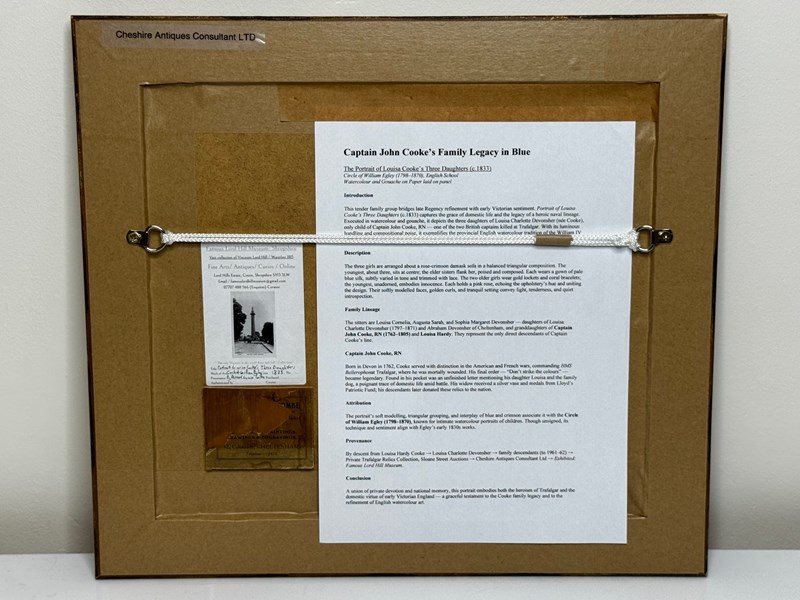
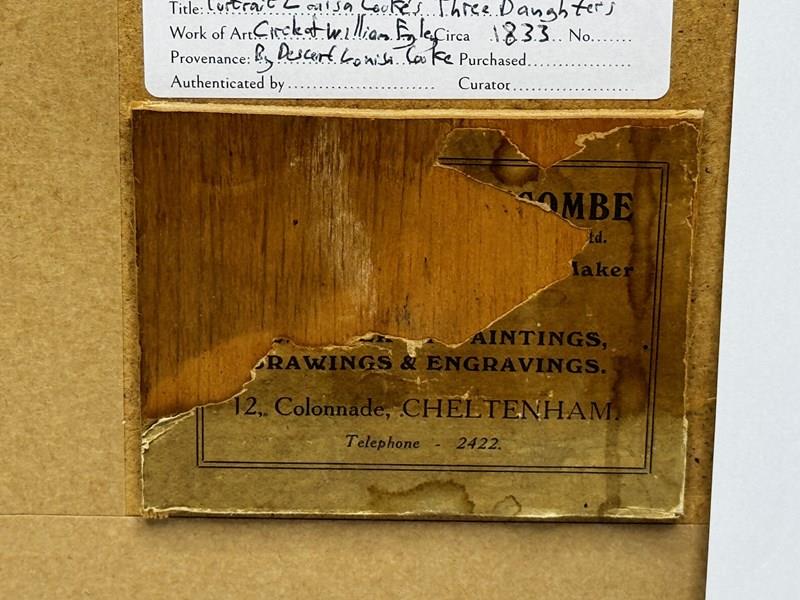
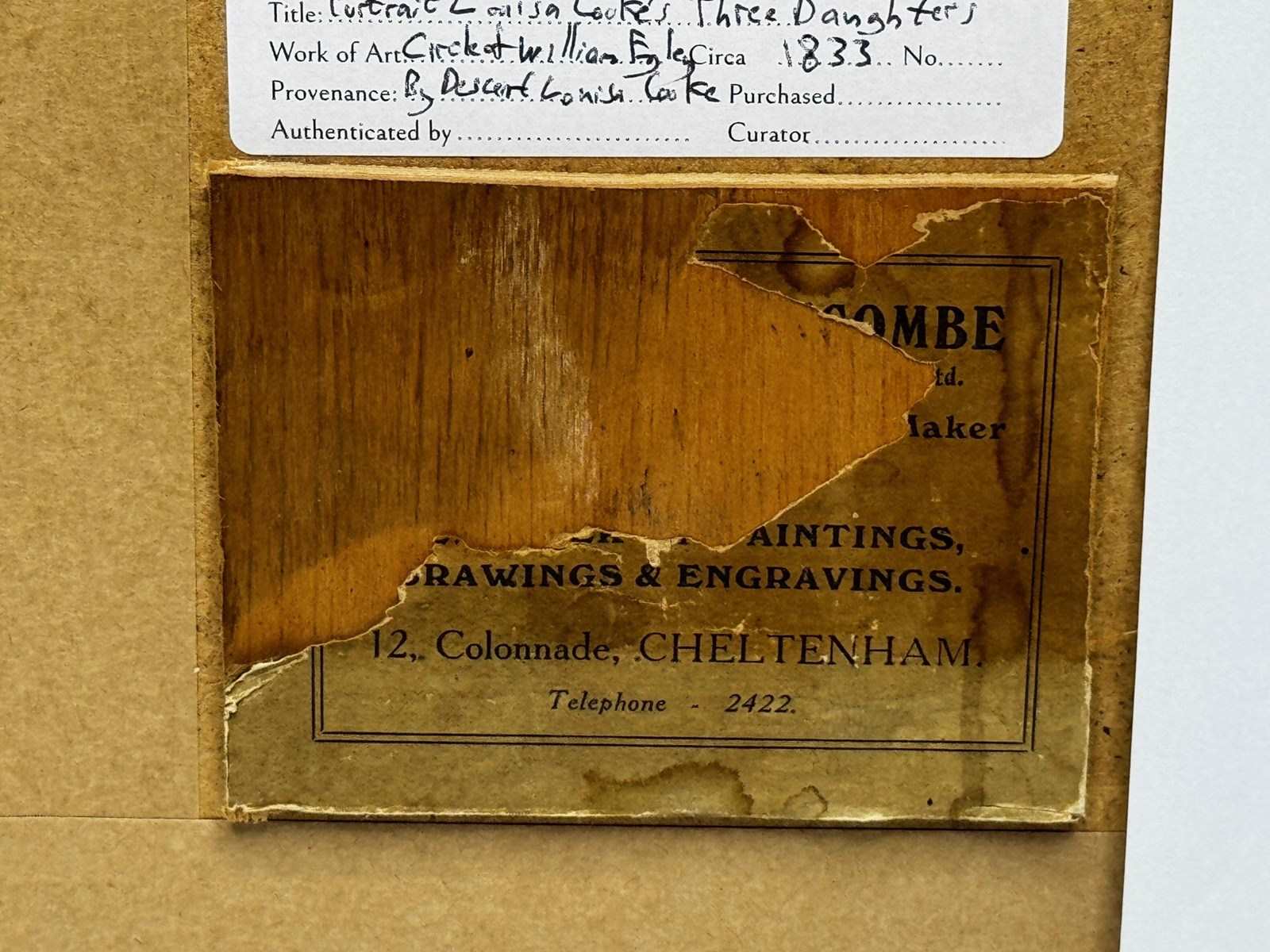
Provenance
By family descent and distinguished collections:
Louisa Hardy Cooke, widow of Captain John Cooke, RN
→ Louisa Charlotte Devonsher (née Cooke)
→ Thence by descent within the Cooke–Devonsher–Rolles family until c.1961–62
→ Private Collection of Trafalgar Relics, associated with a notable London auction house
→ Cheshire Antiques Consultant LTD
Exhibited: Famous Lord Hill Museum
Such a clear chain, anchored in the family of a named Trafalgar captain, is unusually strong for a portrait of this period.
Why You’ll Love It
A beautifully coloured, exquisitely detailed children’s group that enlivens any room.
A direct and well-documented link to Captain John Cooke, RN, fallen hero of Trafalgar, and to the family home at Donhead Lodge.
An evocative synthesis of naval history, Regency–Victorian domestic life, and English watercolour artistry.
Attributable to the Circle of William Egley, bringing connoisseurial interest and art-historical weight.
Superb contemporary presentation in Larson Juhl distressed gilt framing with AR70 glass and a smart black-and-gold mount – ready to hang in a private collection, museum, or historic house setting.
Condition
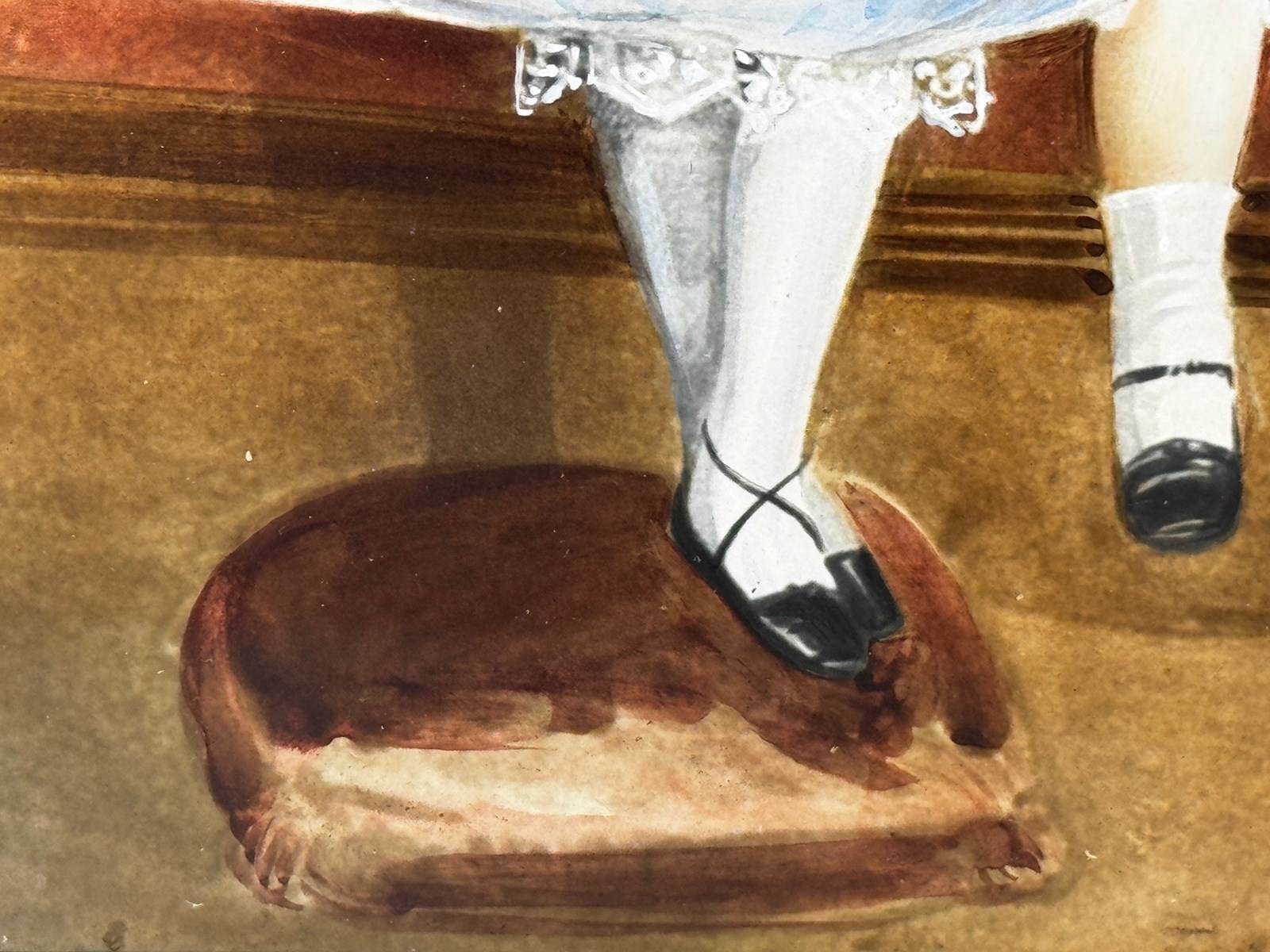
The watercolour and gouache surface is clean, bright and stable, with excellent retention of the original blues and warm flesh tones. Under close inspection, some foxing, age-consistent toning and tiny specks can be detected in the background – entirely typical for a work of the 1830s and not detracting from the overall effect.
The Larson Juhl frame is in excellent condition, with only the lightest handling marks. The newly installed AR70 glass and mount are pristine. Overall, the piece presents beautifully and is securely prepared for long-term display.
How to Purchase
Click Buy It Now to secure this important family portrait before it is gone. Add this museum-worthy document of Trafalgar heritage and early Victorian family life to your collection today.
Explore our gallery Cheshire Antiques Consultant LTD to discover more hand-picked treasures.
Questions or further details required?
Please feel free to send us a message with any enquiries about this piece.
Item Info
Seller Location
Covent Garden, London
Item Dimensions
H: 38cm W: 42cm D: 2.5cm
Period
1833
Item Location
United Kingdom
Seller Location
Covent Garden, London
Item Location
United Kingdom
Seller Contact No
+44 (0)7494 763382
More from CHESHIRE ANTIQUES CONSULTANT LTD